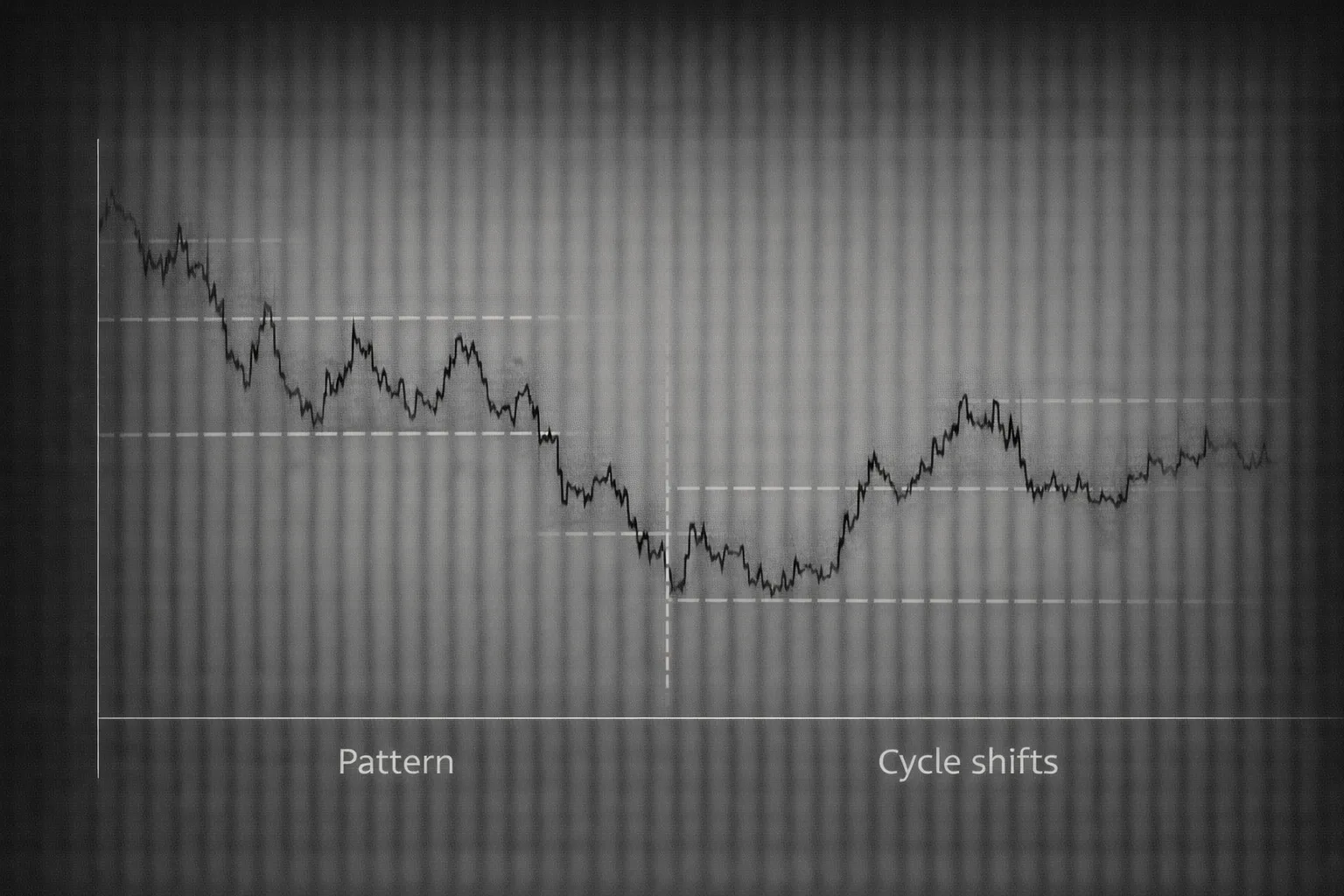
Why Patterns Exist, Repeat, and Eventually Fail
Introduction: Patterns Are Not Shapes
Swing-trading patterns are often treated as visual shortcuts — recognizable shapes that promise repeatable outcomes. This perspective is convenient, but incomplete.
Patterns are not graphical artifacts.
They are behavioral residues.
They emerge because markets do not move continuously. They advance, pause, compress, expand, and reset. Each of these phases produces recurring reactions. What traders later label as patterns are simply visible expressions of cyclical crowd behavior.
To understand swing patterns, one must first understand cycles.
Why Swing Patterns Exist at All
Markets move in waves because participation is uneven.
Capital does not enter and exit markets smoothly. It arrives in bursts, pauses to reassess, and then either reinforces or withdraws. These pauses create swings. Swings create structure. Structure creates recognizable repetition.
Swing patterns exist because:
- trends are not linear
- decisions are not synchronized
- conviction builds and dissipates gradually
A swing is not a technical formation. It is a temporary equilibrium between opposing forces.
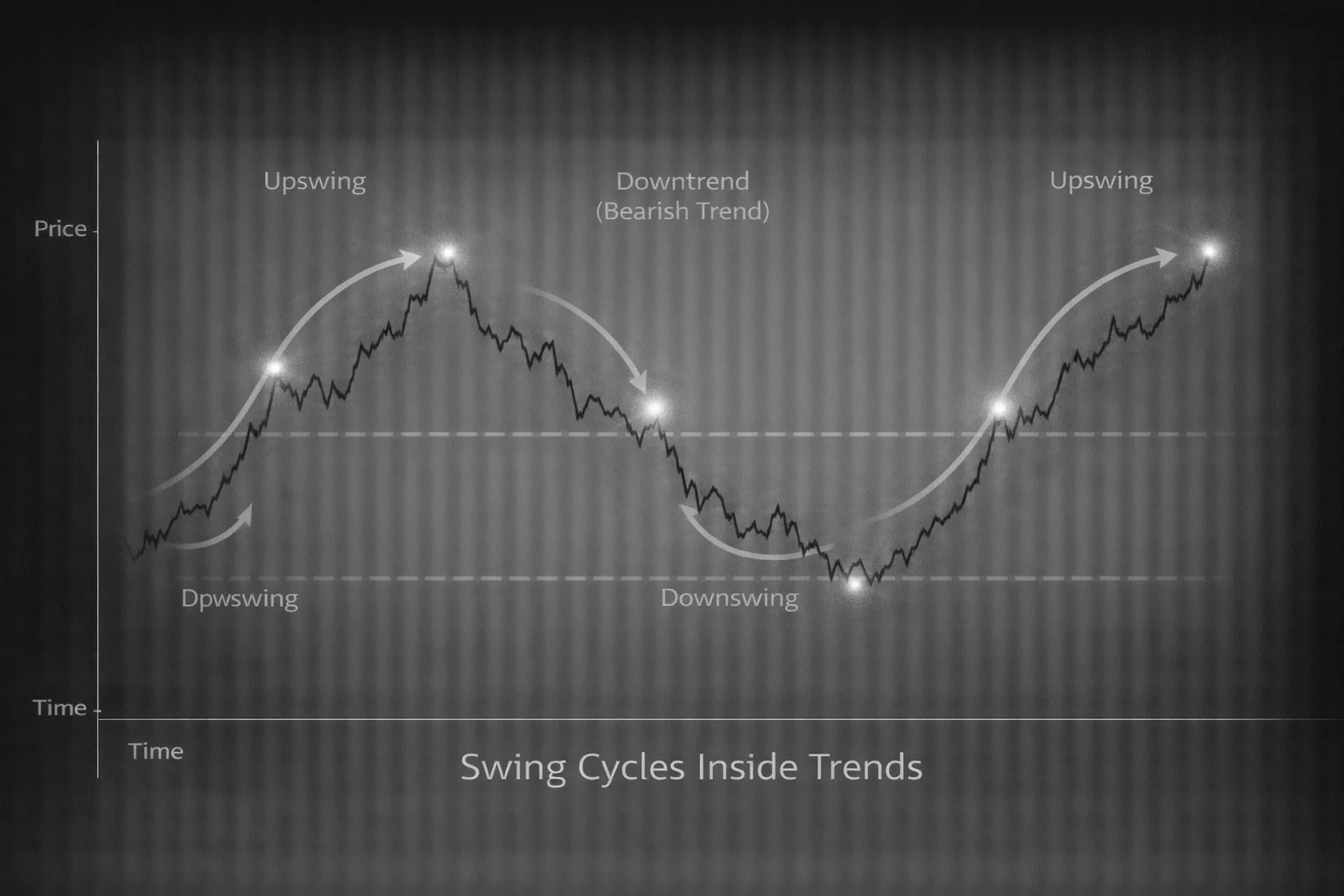
Cycles Create Opportunity Windows
Every market cycle alternates between movement and digestion.
Impulse phases expand price rapidly. Consolidation phases absorb participation. Swing patterns form in the space between these phases — where uncertainty temporarily stabilizes price.
These windows are not random. They appear when:
- early participants reassess
- late participants hesitate
- new information is partially, but not fully, absorbed
Swing-trading patterns are therefore time-bounded opportunities, not permanent structures.
Patterns as Crowd Compression
Patterns represent compression — not balance.
During compression, the crowd is not neutral. It is conflicted. Buyers and sellers are active, but neither side is willing to fully commit. This indecision stores potential energy.
Compression is behavioral, not mechanical.
When compression resolves, price moves not because of a signal, but because the crowd finally aligns. Patterns are simply the visible footprint of that alignment process.
Accumulation-Driven Swing Patterns
In early cycle phases, swing patterns appear subtle and irregular.
Volatility is low. Participation is limited. Price often revisits the same area repeatedly. These patterns feel frustrating because they lack confirmation.
But this is precisely their purpose.
Accumulation-driven swings reflect:
- cautious entry
- gradual position building
- limited public interest
Patterns in this phase rarely look “clean.” Their value lies not in precision, but in persistence.
Expansion-Driven Swing Patterns
As cycles mature, swing patterns become more pronounced.
Volatility increases. Price reacts more decisively. Swings expand in both size and speed. This is where most traders believe patterns “work best.”
They do — temporarily.
Expansion-driven patterns succeed because:
- participation is increasing
- reactions are quickly validated
- failure becomes obvious
However, this clarity is a double-edged sword. The more visible a pattern becomes, the closer it moves toward saturation.
Distribution-Driven Swing Patterns
Late-cycle swing patterns feel familiar, but behave differently.
Price still swings, but reactions weaken. Breakouts fail more often. Swings shorten. Volatility becomes erratic rather than directional.
This phase confuses traders because the shape remains, but the outcome changes.
Distribution-driven patterns are deceptive because they mimic earlier phases while lacking the underlying participation necessary for continuation.
Pattern recognition without cycle awareness fails here.
Why Swing Patterns Fail
Patterns do not fail randomly.
They fail structurally.
Failure occurs when:
- the underlying cycle shifts
- participation saturates
- the crowd’s behavior changes
The pattern remains visible, but its meaning disappears.
This is why pattern libraries mislead. They preserve the form while discarding the context. What once represented opportunity becomes noise.
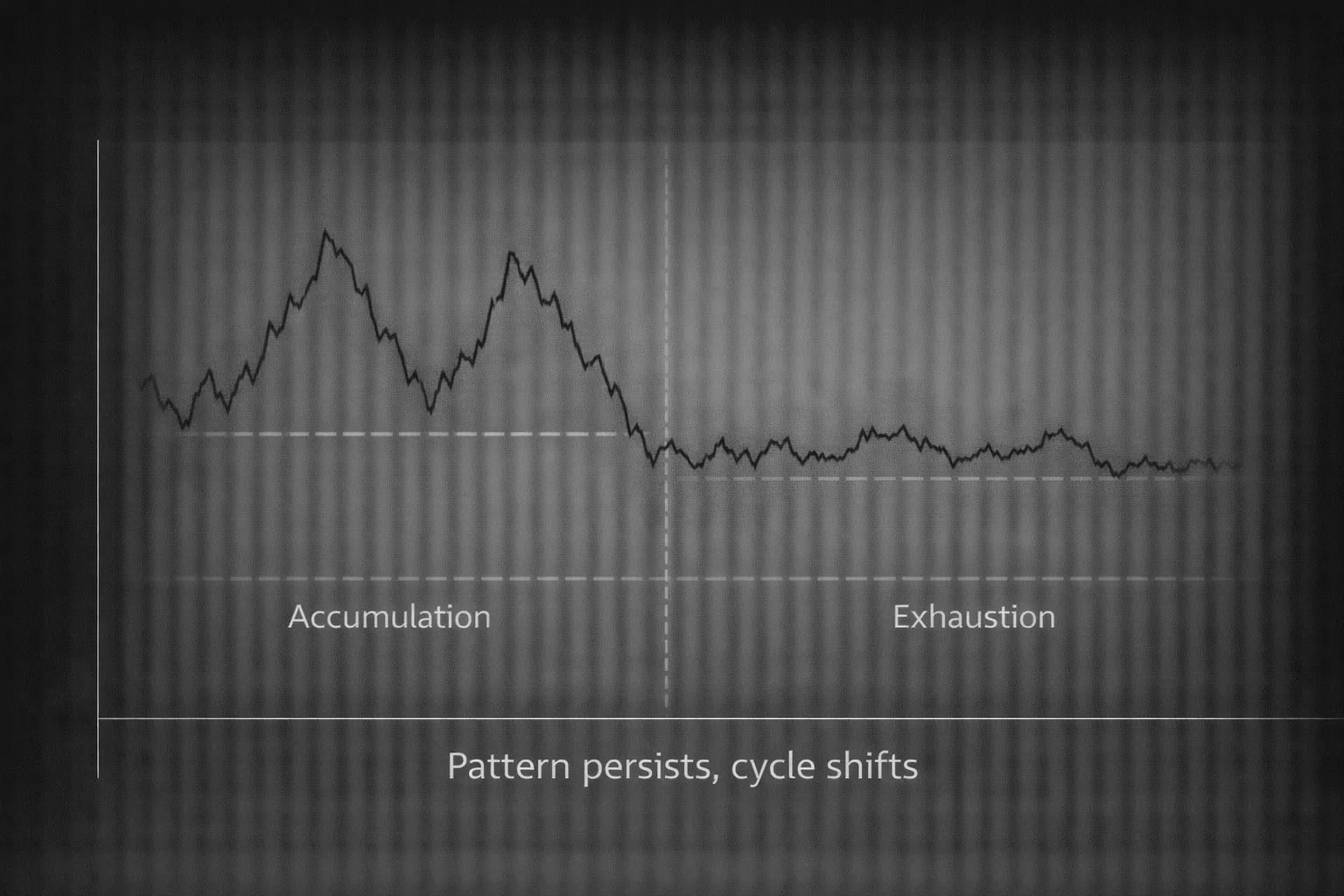
Time Compression and Swing Cycles
Swing patterns are scale-invariant.
They appear:
- intraday
- across days
- across weeks
The structure remains the same because human behavior remains the same. Only the time horizon changes.
Understanding swing cycles is therefore not about choosing the correct timeframe. It is about recognizing where compression and expansion occur relative to the broader cycle.
Why Pattern Libraries Are Misleading
Pattern catalogs isolate form from cause.
They teach recognition without explanation. Traders memorize shapes without understanding why those shapes appear — or why they disappear.
Patterns do not function independently. They are conditional. Without cycle awareness, recognition becomes superstition.
Swing Patterns as Context, Not Signals
A swing pattern is not a trade.
It is a situation.
It describes:
- the state of participation
- the degree of compression
- the likelihood of expansion
Execution is a separate question.
Treating patterns as signals collapses context into instruction. Treating them as context preserves flexibility.
Conclusion: Cycles Trade Patterns, Not Traders
Swing patterns are consequences, not causes.
They exist because cycles exist. They repeat because behavior repeats. They fail because conditions change.
Traders who chase patterns trade shadows.
Traders who understand cycles trade structure.
Patterns will always appear on charts.
Understanding why they appear is what separates repetition from comprehension.