Introduction: Markets as Rhythmic Systems
Financial markets are often described as unpredictable, chaotic, and driven by random events. Yet a deeper historical examination reveals a radically different perspective: markets behave as rhythmic systems, governed by recurring forces that manifest over time. While price appears erratic on the surface, its movements follow patterns that have repeated across decades, market structures, and technological eras.
The notion that markets move in cycles is not a modern discovery. Long before computers and statistical models, early market observers recognized that advances and declines did not occur in isolation. Instead, they unfolded as part of broader sequences — expansions followed by contractions, optimism followed by fear, accumulation followed by distribution. These sequences were not viewed as accidents, but as the natural outcome of human behavior interacting with capital and time.
Understanding the origins of market cycles requires abandoning the idea that price alone explains market behavior. Instead, one must examine time, structure, and collective psychology as equally important forces shaping market movements.

The Concept of Recurrence in Market Behavior
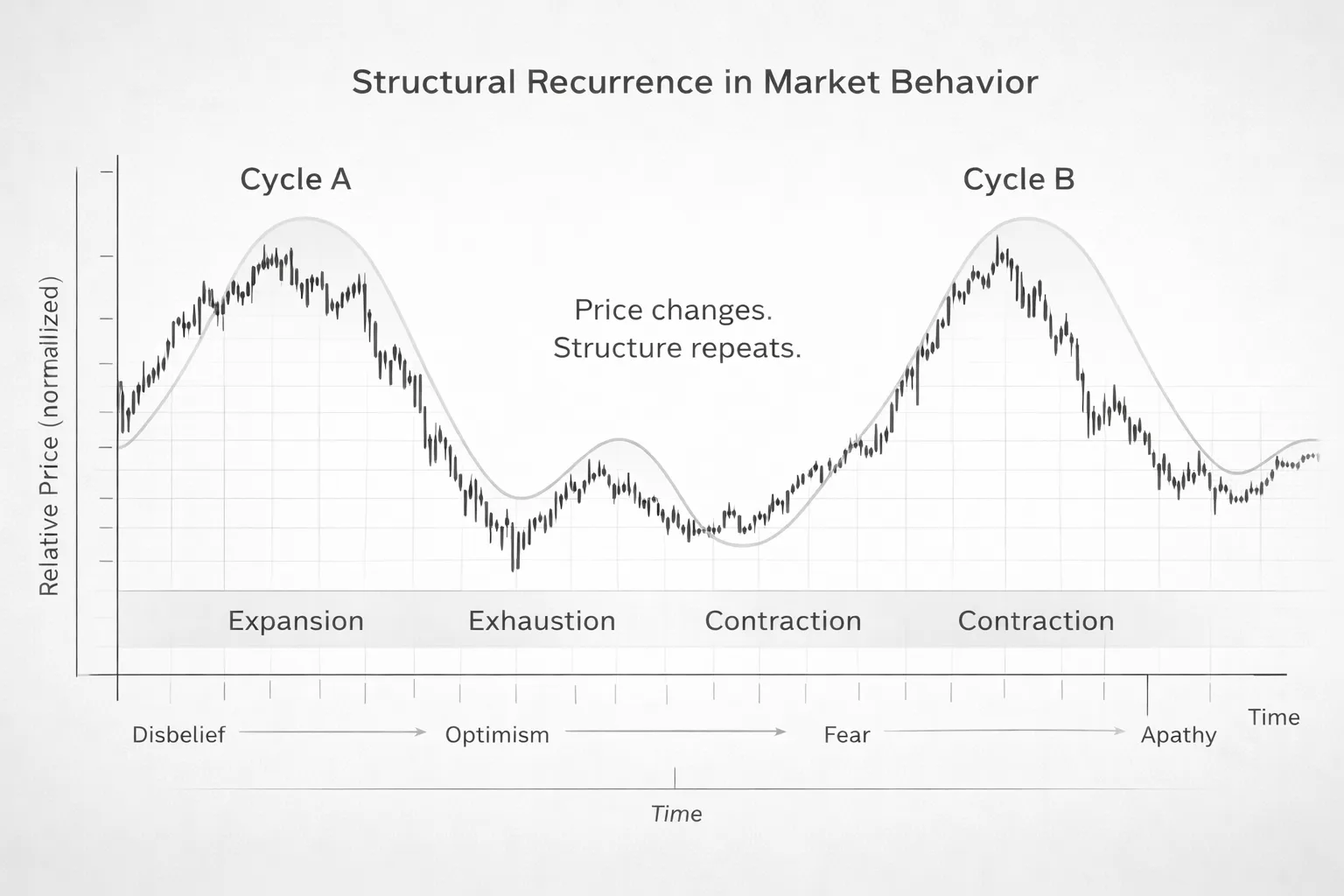
One of the earliest insights into market behavior was the recognition that history does not repeat mechanically, but structurally. Market events may differ in scale, instruments, and narratives, yet their underlying patterns remain remarkably consistent.
Periods of intense activity are invariably followed by periods of rest. Strong advances lead to eventual exhaustion. Sharp declines give way to stabilization and recovery. These transitions are not random; they reflect a recurring process of imbalance and rebalancing.
At the core of this process lies human behavior. Market participants respond to opportunity, risk, and uncertainty in broadly predictable ways. When prices rise steadily, confidence grows, participation increases, and risk tolerance expands. Conversely, when prices fall, fear dominates, participation contracts, and capital retreats. These emotional responses do not change with time or technology. They are deeply rooted in human psychology.
As a result, markets exhibit periodicity — a tendency to move in waves rather than straight lines. These waves form the basis of market cycles.
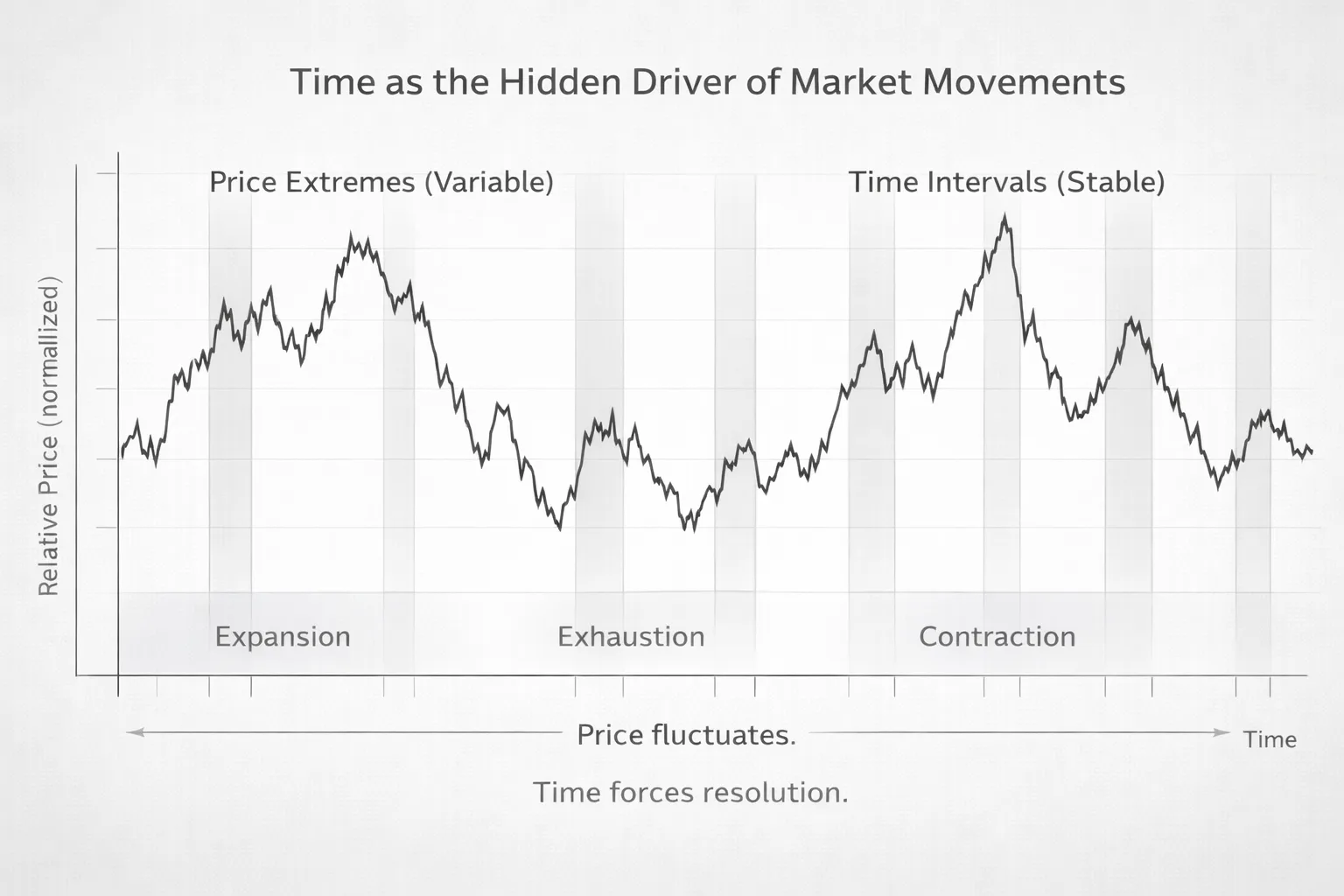
Time as the Hidden Driver of Market Movements
While price attracts most attention, time plays a far more decisive role in determining market turning points. Major reversals often occur not because prices have reached a specific numerical level, but because a sufficient amount of time has passed.
Markets can remain overvalued or undervalued longer than participants expect. What ultimately forces change is not price extremity, but duration. Prolonged advances create conditions of saturation, where marginal buyers diminish. Extended declines exhaust selling pressure, setting the stage for stabilization.
Time acts as a balancing mechanism. It governs the maturation of trends, the dissipation of momentum, and the transition between market phases. Ignoring time leads to premature conclusions; respecting it provides context.
This time-based perspective explains why markets frequently reverse when sentiment appears strongest. By the time optimism becomes widespread, the cycle is often nearing completion. Similarly, despair tends to peak near the end of declines, not the beginning.
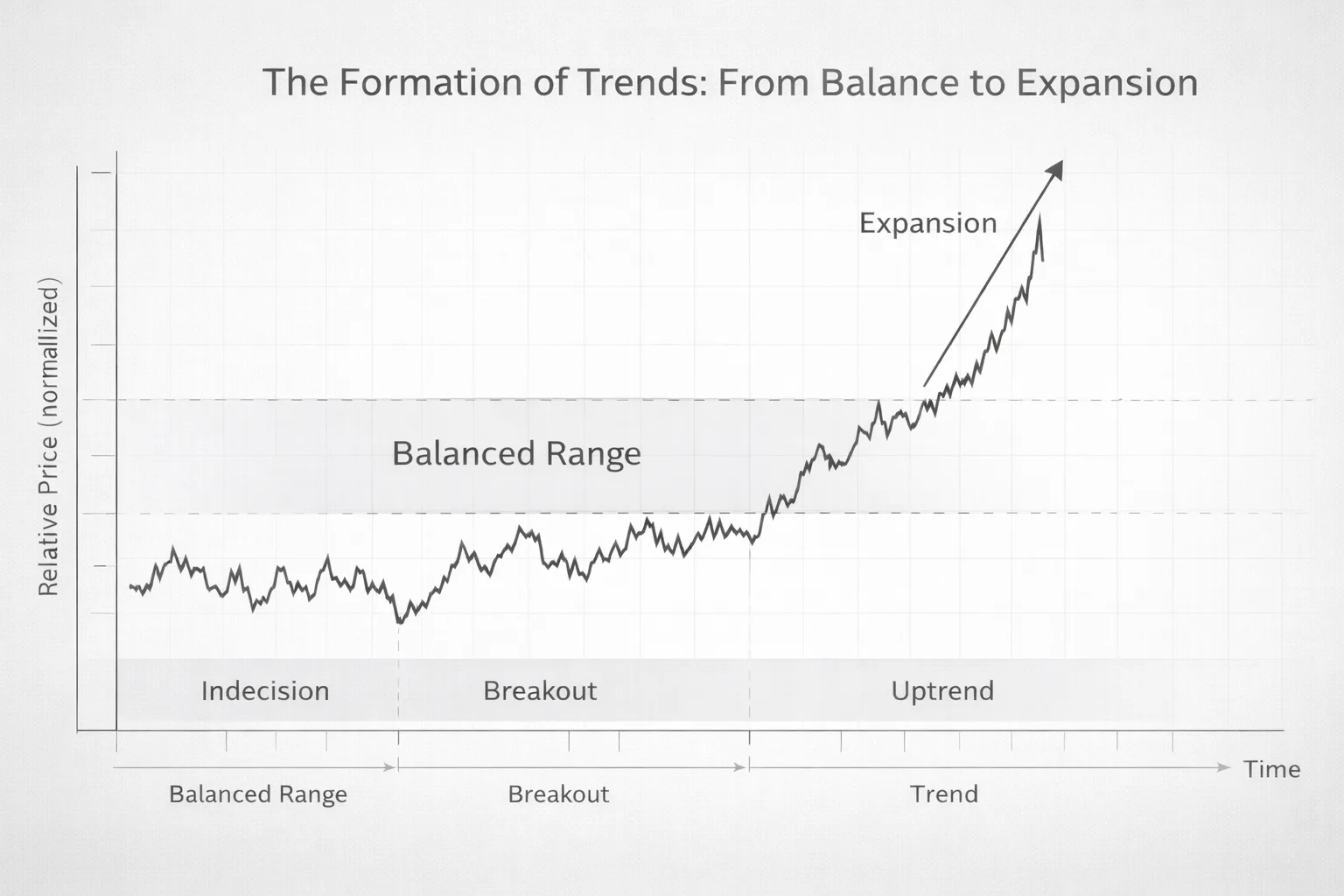
The Formation of Trends: From Balance to Expansion
Trends do not emerge spontaneously. They are the product of prior structural conditions.
Before a sustained upward or downward movement can develop, markets typically pass through phases of relative equilibrium. During these periods, buying and selling pressures are largely balanced. Price fluctuations narrow, volatility contracts, and activity appears subdued. To casual observers, these phases seem uninteresting or directionless.
In reality, these quiet periods are critical. They represent the preparation stage of a new trend. Capital gradually shifts hands, expectations realign, and pressure builds beneath the surface. When the balance eventually breaks, the resulting movement often appears sudden and decisive.
Once a trend begins, it tends to persist. This persistence is not driven by continuous new information, but by structural inertia. Market participants anchor their expectations to recent price action, reinforcing the trend. Late entrants amplify movement, while early participants hesitate to exit.
Thus, trends are not merely directional movements; they are collective behavioral phenomena, rooted in prior cycles of accumulation and distribution.
Accumulation, Distribution, and Market Phases
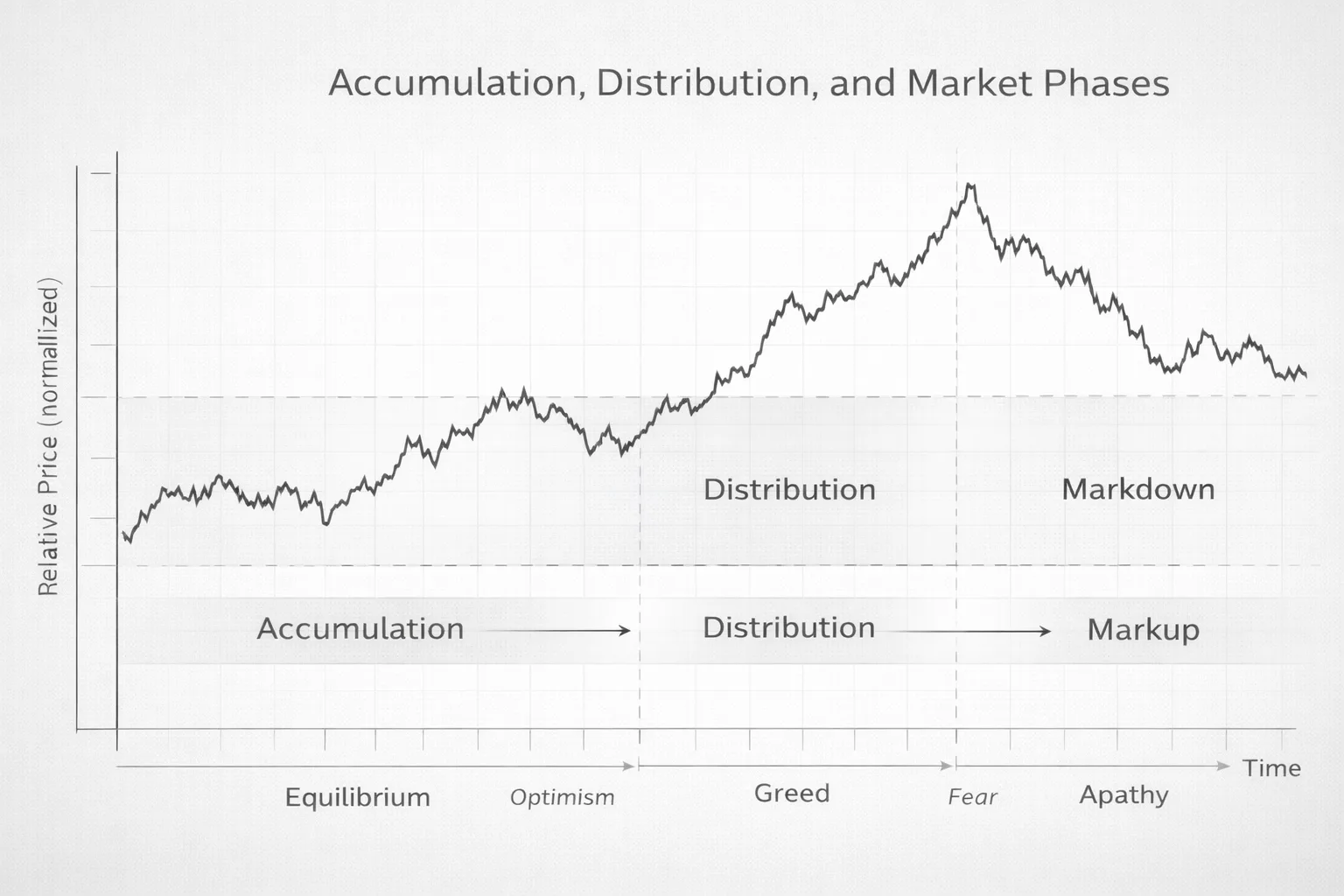
Every market cycle consists of distinct phases, each characterized by different participant behavior.
In accumulation phases, informed participants quietly build positions while broader sentiment remains skeptical. Prices stabilize, but confidence is low. Activity is selective, not widespread.
As the cycle progresses into expansion, confidence grows. Participation broadens, trends become visible, and price movement accelerates. This is the phase most commonly associated with opportunity, yet it is not the beginning of the cycle — it is the middle.
Eventually, expansion gives way to distribution. Optimism peaks, participation becomes indiscriminate, and risk tolerance reaches extremes. Prices may still rise, but internal strength deteriorates. This phase is often misinterpreted as strength, when it is in fact a sign of maturation.
The final phase is contraction. Selling pressure overwhelms demand, confidence collapses, and prices decline. This phase cleanses excess and resets expectations, paving the way for the next cycle.
These phases repeat not because markets are predictable machines, but because human reactions to profit and loss are consistent.
Public Perception Versus Structural Reality
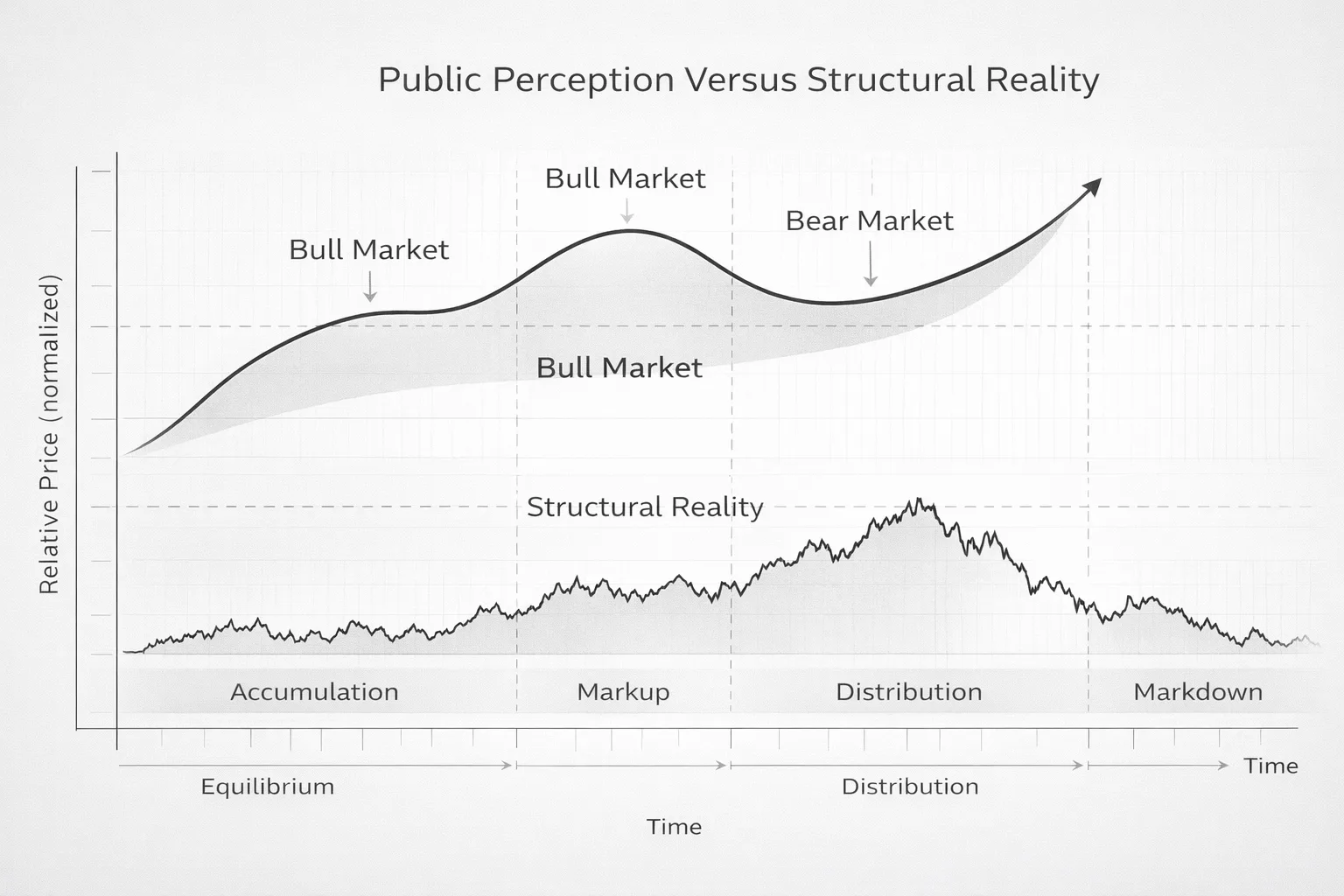
A recurring theme throughout market history is the disconnect between public perception and structural reality. Market participants tend to focus on immediate causes: news, events, and narratives. Structural forces — time, positioning, and cycle maturity — operate quietly in the background.
As a result, turning points often appear surprising. Advances end when news is good; declines bottom when news is bleak. This apparent contradiction arises because markets move ahead of perception, not in response to it.
By the time information becomes widely accepted, its impact is already reflected in price. What remains is the gradual exhaustion of the prevailing cycle.
Understanding this dynamic is essential. Markets do not turn because participants agree; they turn because imbalance has reached its limit.
Cycles as Context, Not Prediction
It is important to clarify what market cycles represent — and what they do not.
Cycles are not precise forecasting tools. They do not specify exact prices or dates. Instead, they provide context. They define the environment in which certain outcomes become more or less probable.
Recognizing whether a market is early, mid, or late in a cycle changes how information should be interpreted. It explains why the same event can have different effects at different times. It also clarifies why strategies perform well during certain periods and poorly during others.
Cycles frame opportunity; they do not guarantee it.

Continuity Across Decades
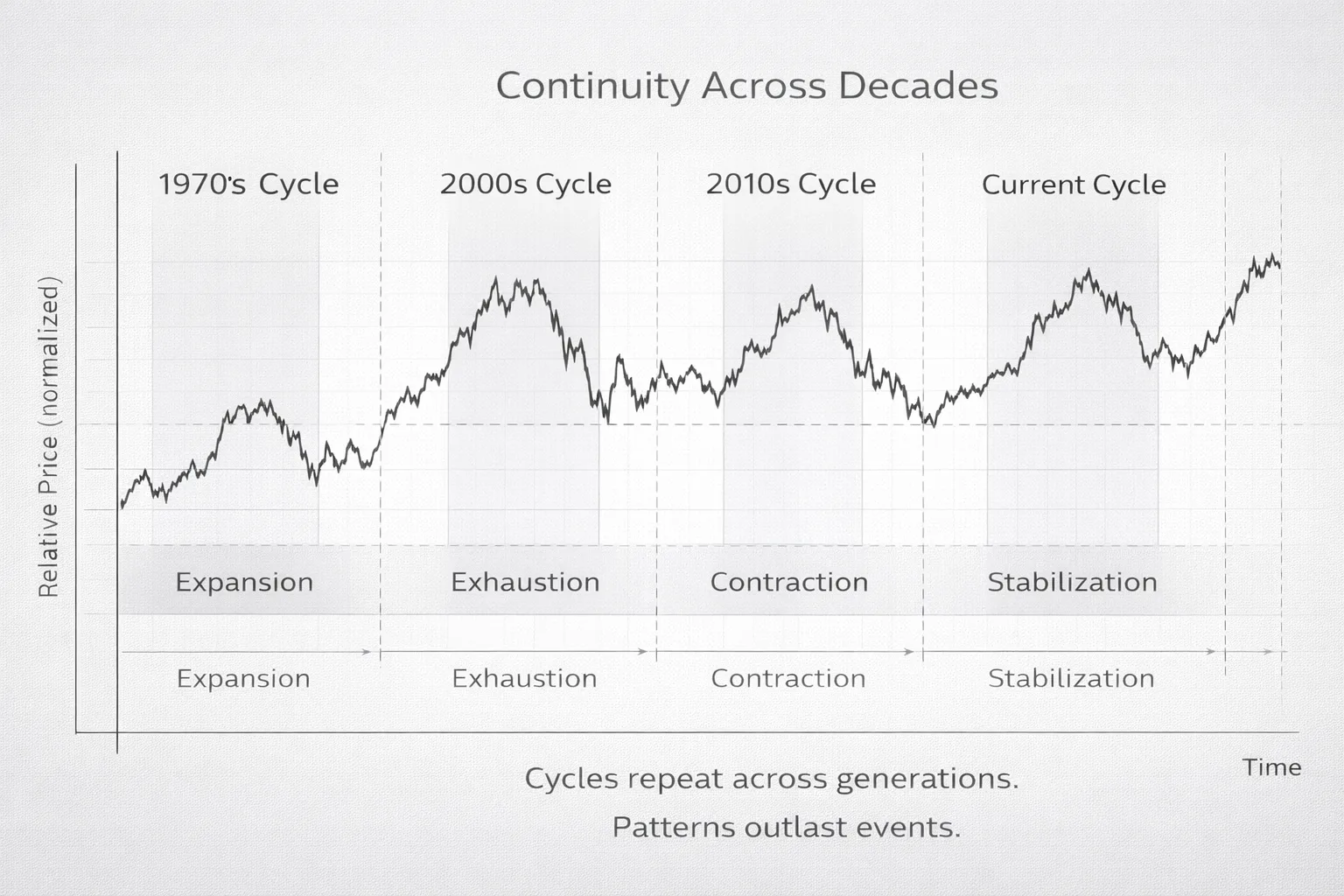
One of the most compelling aspects of market cycles is their persistence across vastly different eras. Markets have evolved technologically, structurally, and geographically — yet their rhythmic behavior remains intact.
This continuity suggests that cycles are not artifacts of specific systems or rules. They are expressions of capital interacting with human decision-making over time.
Modern analytical tools may describe these behaviors using different language — regimes, volatility clusters, momentum persistence — but the underlying phenomenon is unchanged. The market still breathes in expansions and contractions. It still oscillates between fear and greed. It still moves in rhythms.
Conclusion: Markets Move Because Humans Do
At their core, market cycles exist because humans are cyclical beings. Confidence builds and fades. Risk tolerance expands and contracts. Attention shifts between opportunity and preservation.
Markets aggregate these individual behaviors into collective motion. The result is not randomness, but rhythm.
Understanding the origins of market cycles is not about mastering prediction. It is about recognizing where we are within the rhythm, and adjusting expectations accordingly.
Trends form because cycles demand resolution. Markets move because imbalance cannot persist indefinitely. And patterns repeat not because history is scripted, but because human behavior remains constant.