Introduction: Why Backtests Fail Traders
Most trading strategies do not fail because their logic is flawed.
They fail because their evaluation process is structurally naïve.
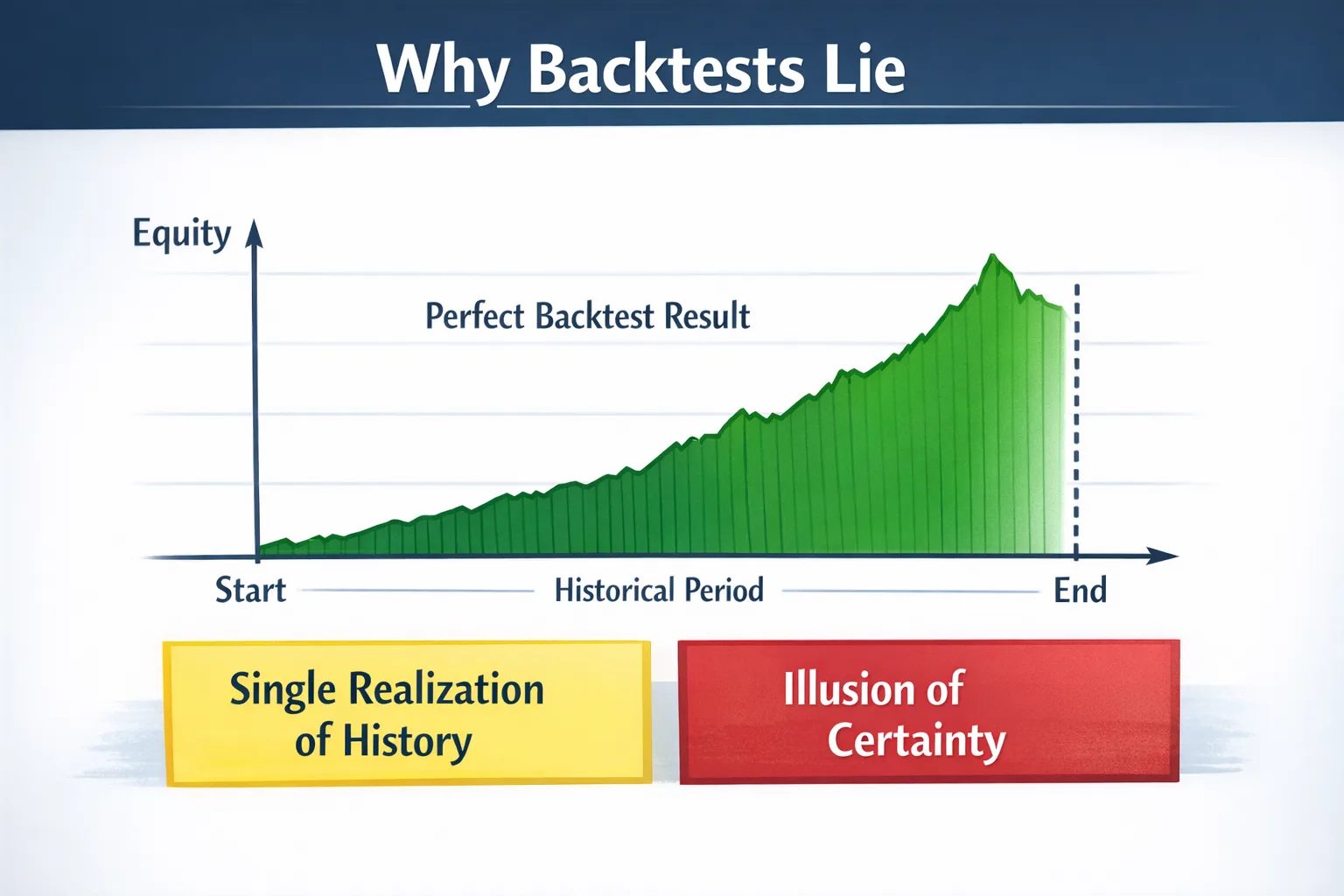
Backtests look convincing. Equity curves rise smoothly. Risk metrics appear controlled. Optimization reports show statistically significant results. And yet, once deployed, these same systems degrade — often rapidly and without warning.
This is not bad luck.
It is not randomness.
It is misplaced confidence in historical precision.
Markets are non-stationary systems. Any methodology that assumes stability where none exists will eventually collapse. Robust strategy design exists to confront this reality directly.
Walk-forward analysis is not a technique for improving performance.
It is a filter for survivability.
1. Performance Is an Outcome, Not a Property
Performance is not something a strategy “has.”
Performance is something a strategy produces under specific conditions.
A trading system is best understood as a mapping:
Market Structure → Rules → Capital Exposure → Observed Results
Change the structure, and the same rules yield a different result. This is not a defect; it is a fundamental property of adaptive systems.
Robust strategy design therefore rejects absolute performance metrics as primary decision tools. Net profit, Sharpe ratio, and win rate are all outputs. None of them describe structural validity.
What matters instead is behavioral consistency:
- Does the system respond coherently to regime shifts?
- Does performance degrade gradually or catastrophically?
- Does risk expand under stress or remain bounded?
These questions cannot be answered by a single backtest.
2. The Optimization Trap
Optimization is one of the most misunderstood tools in systematic trading.
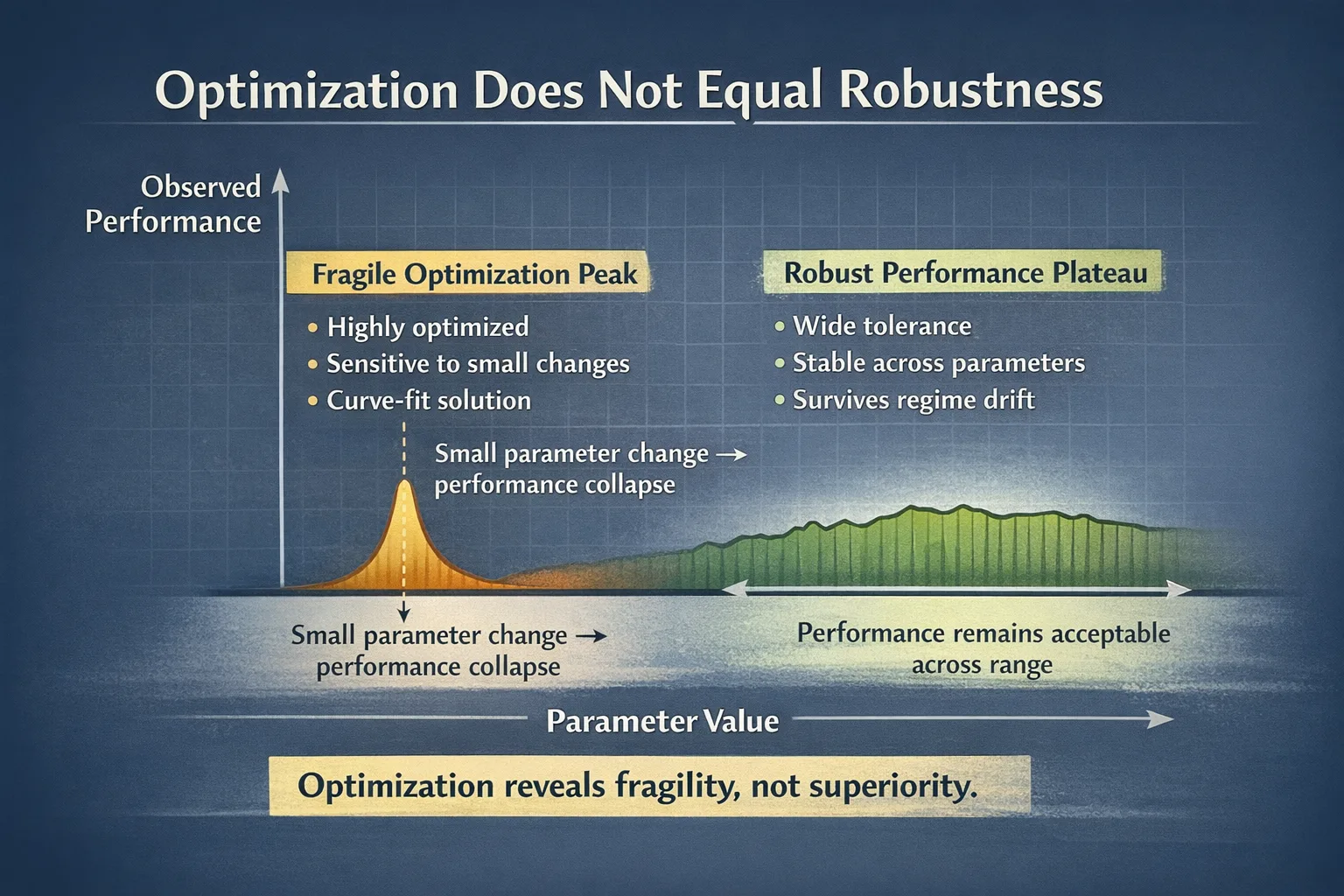
Most traders treat optimization as a method to find the best parameters. In reality, its most important function is to expose fragility.
An optimization surface is not a recommendation engine.
It is a diagnostic landscape.
- Broad plateaus indicate structural tolerance.
- Narrow peaks indicate overfitting.
- Sharp cliffs indicate regime dependence.
Robust strategies are not those with the highest peak, but those with acceptable performance across wide parameter ranges.
Optimization should be used to eliminate ideas, not to select them.
3. Degrees of Freedom and Hidden Complexity
Every adjustable parameter increases the system’s degrees of freedom.
More degrees of freedom allow better historical fit — and dramatically increase the probability of failure out-of-sample.
This is the central paradox of system design:
The more precisely a system fits the past, the less it belongs to the future.
Robust strategies minimize:
- Parameter count
- Conditional branching
- Regime-specific tuning
- Execution micro-optimizations
Walk-forward analysis exists primarily to expose excessive degrees of freedom that static testing cannot detect.
4. Why In-Sample / Out-of-Sample Is Insufficient
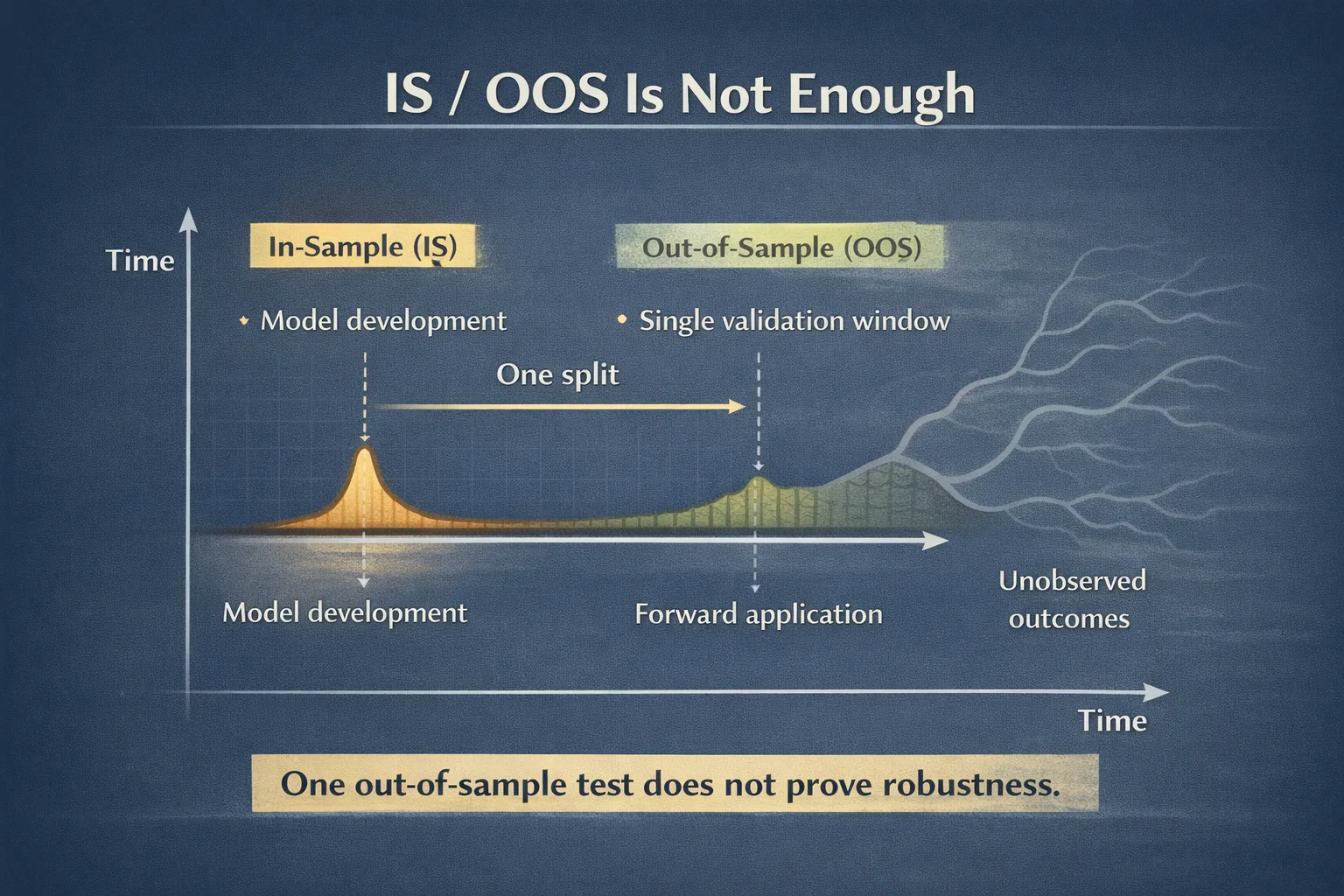
Separating data into in-sample and out-of-sample segments is a necessary step — but it is not sufficient.
A single out-of-sample period is still:
- One historical realization
- One volatility regime
- One liquidity environment
Passing OOS once does not prove robustness.
It merely proves non-failure under one scenario.
Walk-forward analysis replaces this binary logic with continuous validation.
5. The Walk-Forward Framework
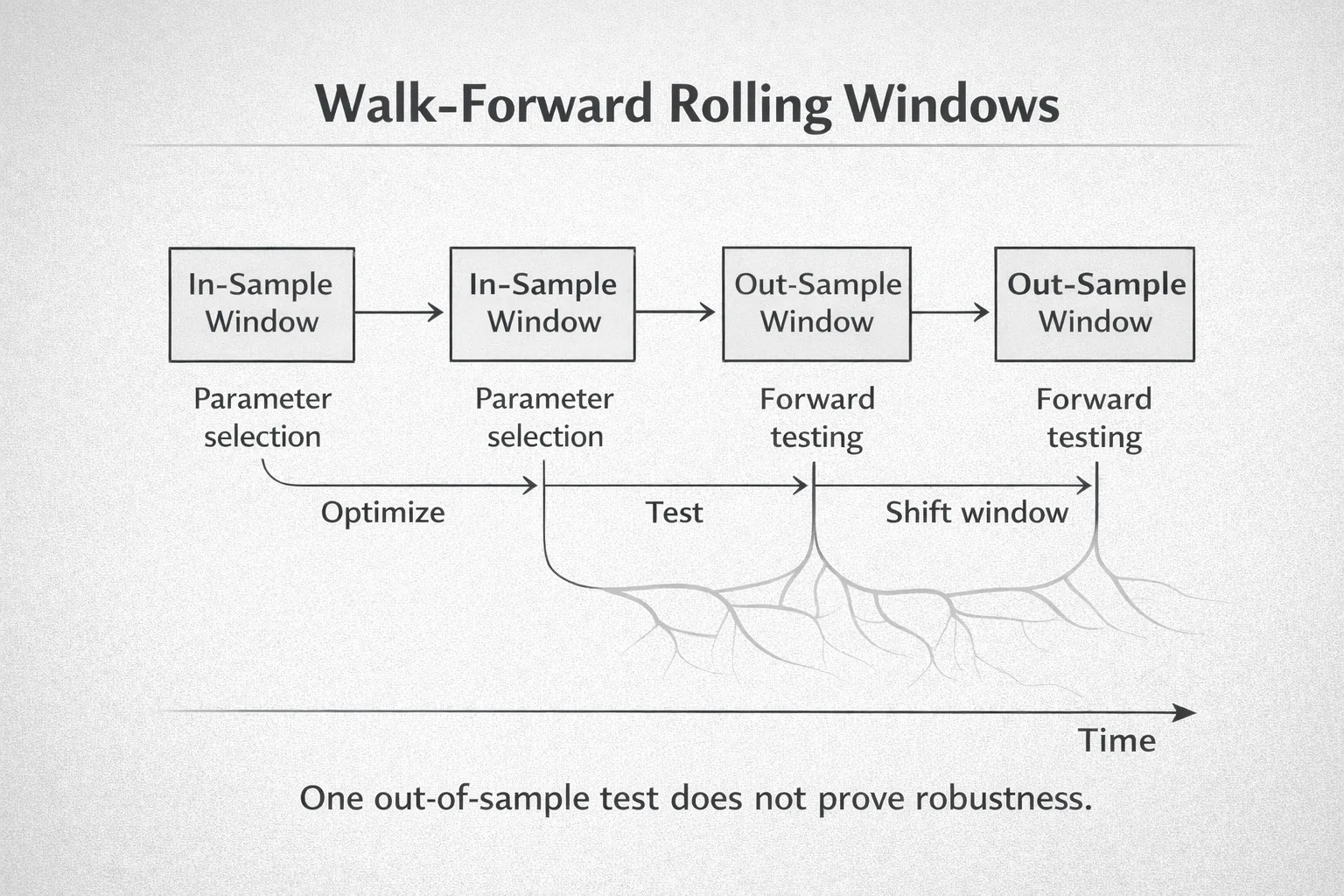
At its core, walk-forward analysis enforces a repeated sequence:
- Select parameters on historical data
- Apply them forward without modification
- Measure degradation
- Refit
- Repeat
This process mirrors the lifecycle of real trading systems.
Instead of asking:
“Did the system work?”
Walk-forward asks:
“How consistently does it adapt without collapsing?”
6. Window Design: How Much History Matters
Choosing window length is not a technical detail.
It is a philosophical assumption.
Short windows:
- React faster
- Overfit more easily
- Are sensitive to noise
Long windows:
- Smooth noise
- Lag regime shifts
- Assume historical relevance
There is no “correct” window. There is only window coherence — alignment between:
- Strategy logic
- Market structure
- Refit frequency
Walk-forward exposes window mismatch brutally.
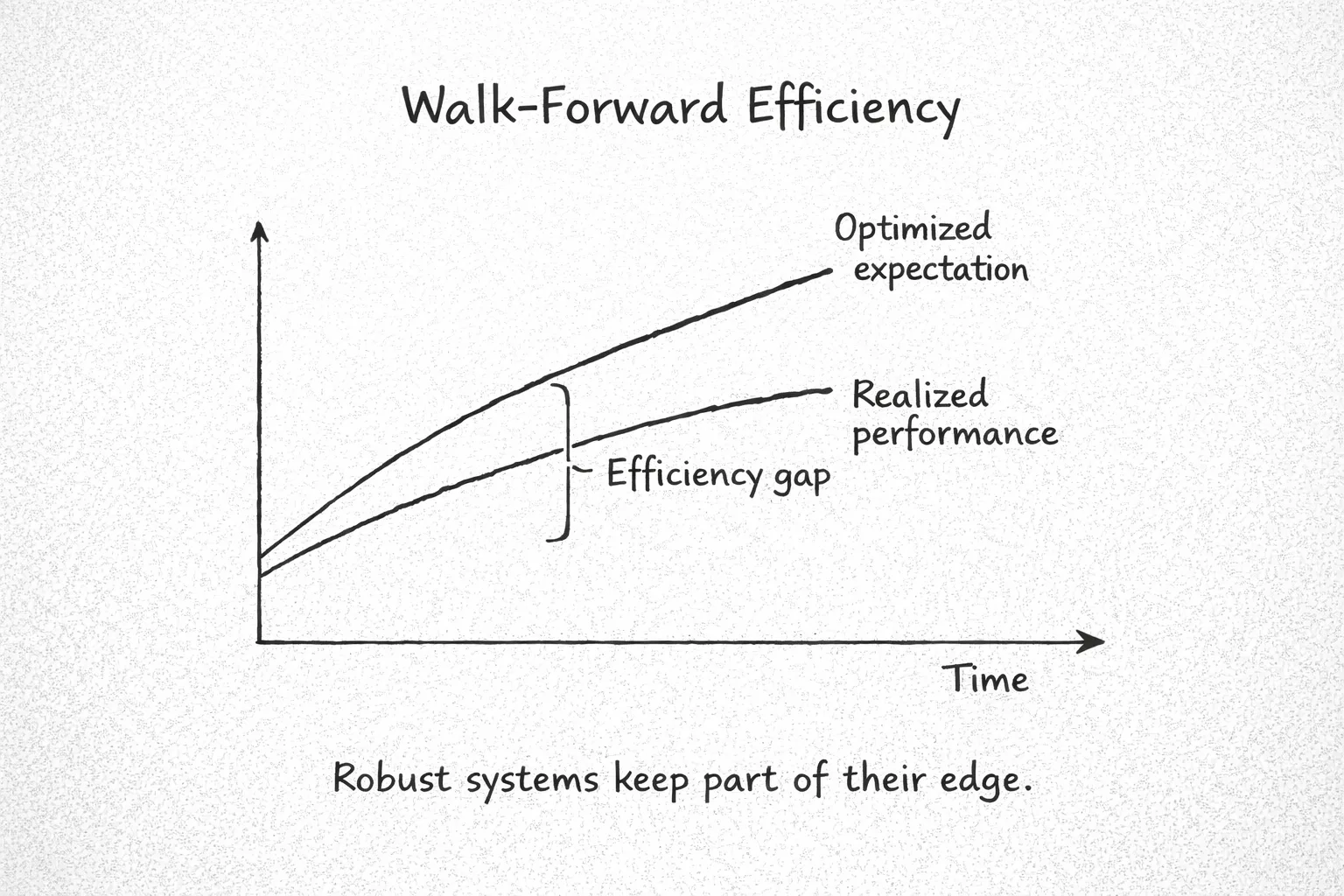
7. Walk-Forward Efficiency: Measuring Reality Capture
Walk-forward efficiency (WFE) measures how much optimized potential survives forward application.
High WFE indicates:
- Structural relevance
- Parameter stability
- Limited regime dependence
Low WFE indicates:
- Curve-fitting
- Fragile assumptions
- Over-optimized logic
Importantly, WFE reframes evaluation:
- High backtest + low WFE = rejected
- Moderate backtest + high WFE = viable
- Smooth equity + unstable WFE = dangerous
8. Robustness vs Precision
Robust systems are rarely precise.
They enter late.
They exit imperfectly.
They tolerate drawdowns.
What they do not do is collapse.
Precision is seductive. Robustness is survivable.
Walk-forward analysis systematically penalizes precision and rewards tolerance.
9. Rolling Windows and Regime Drift
Markets drift continuously.
Volatility, participation, and correlation structures change slowly — until they don’t.
Rolling walk-forward windows allow developers to observe:
- Gradual degradation
- Sudden structural breaks
- Asymmetric recovery
This information is far more valuable than profit.
10. Parameter Stability Over Time
Stable parameters indicate:
- Structural alignment
- Low sensitivity
- Broad applicability
Unstable parameters indicate:
- Noise fitting
- Regime anchoring
- Strategy fragility
Walk-forward highlights whether parameters oscillate, drift, or explode — each signaling a different failure mode.
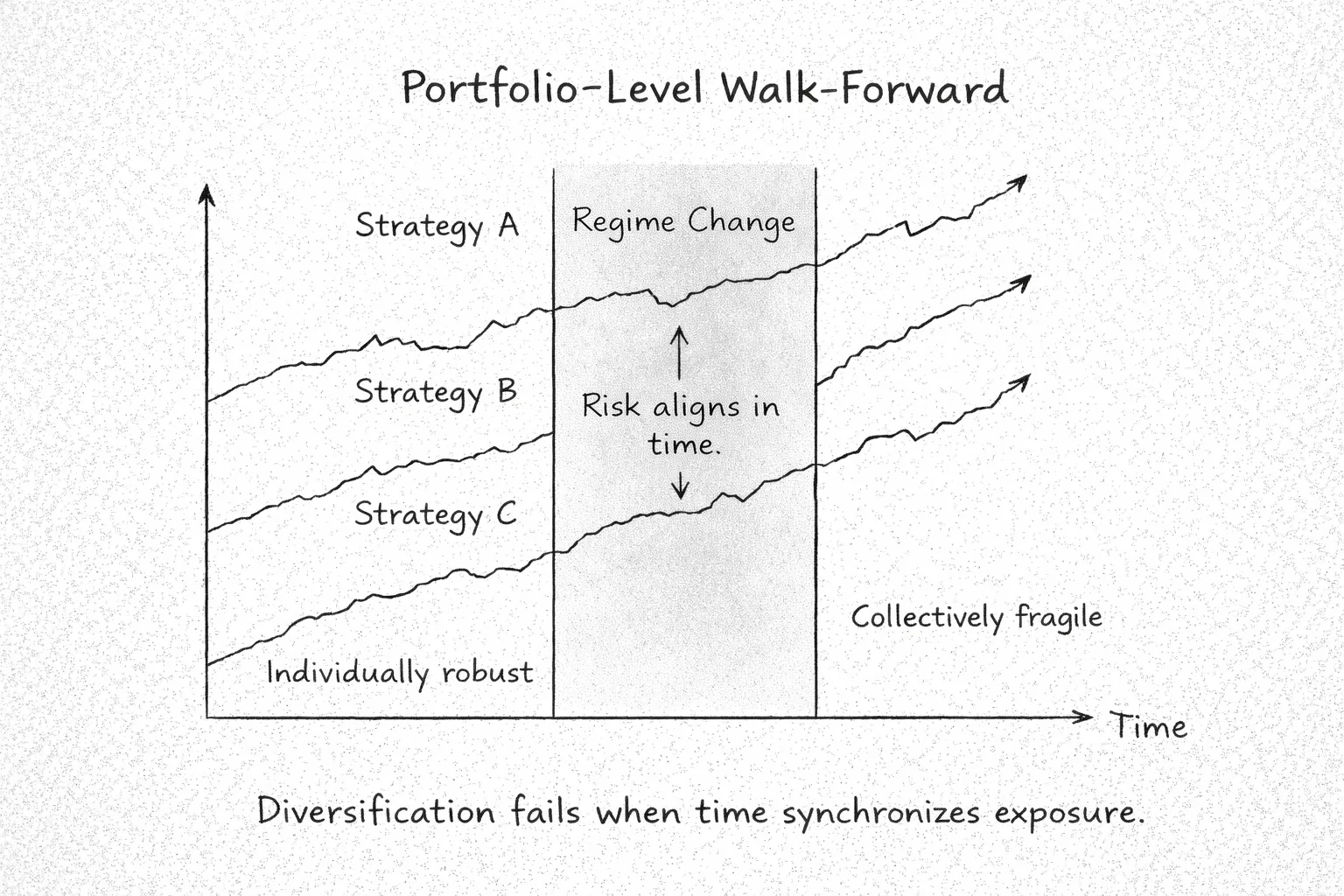
11. Portfolio-Level Walk-Forward
Single-strategy walk-forward is insufficient for capital allocation.
Robust design must consider:
- Correlated failures
- Synchronized drawdowns
- Regime clustering
Portfolio-level walk-forward reveals whether diversification is structural or illusory.
12. Why Adaptive Systems Fail Faster
Adaptive systems promise self-correction.
In practice, they often accelerate failure.
Why?
- They chase noise
- They amplify recent anomalies
- They reduce human oversight
Walk-forward analysis often reveals that adaptive logic increases short-term fit while reducing long-term survivability.
13. Drawdown as Time Exposure
Drawdown is not just a percentage loss.
It is time under uncertainty.
Robust systems minimize:
- Drawdown duration
- Recovery asymmetry
- Capital stagnation
Walk-forward exposes whether drawdowns cluster or resolve smoothly.
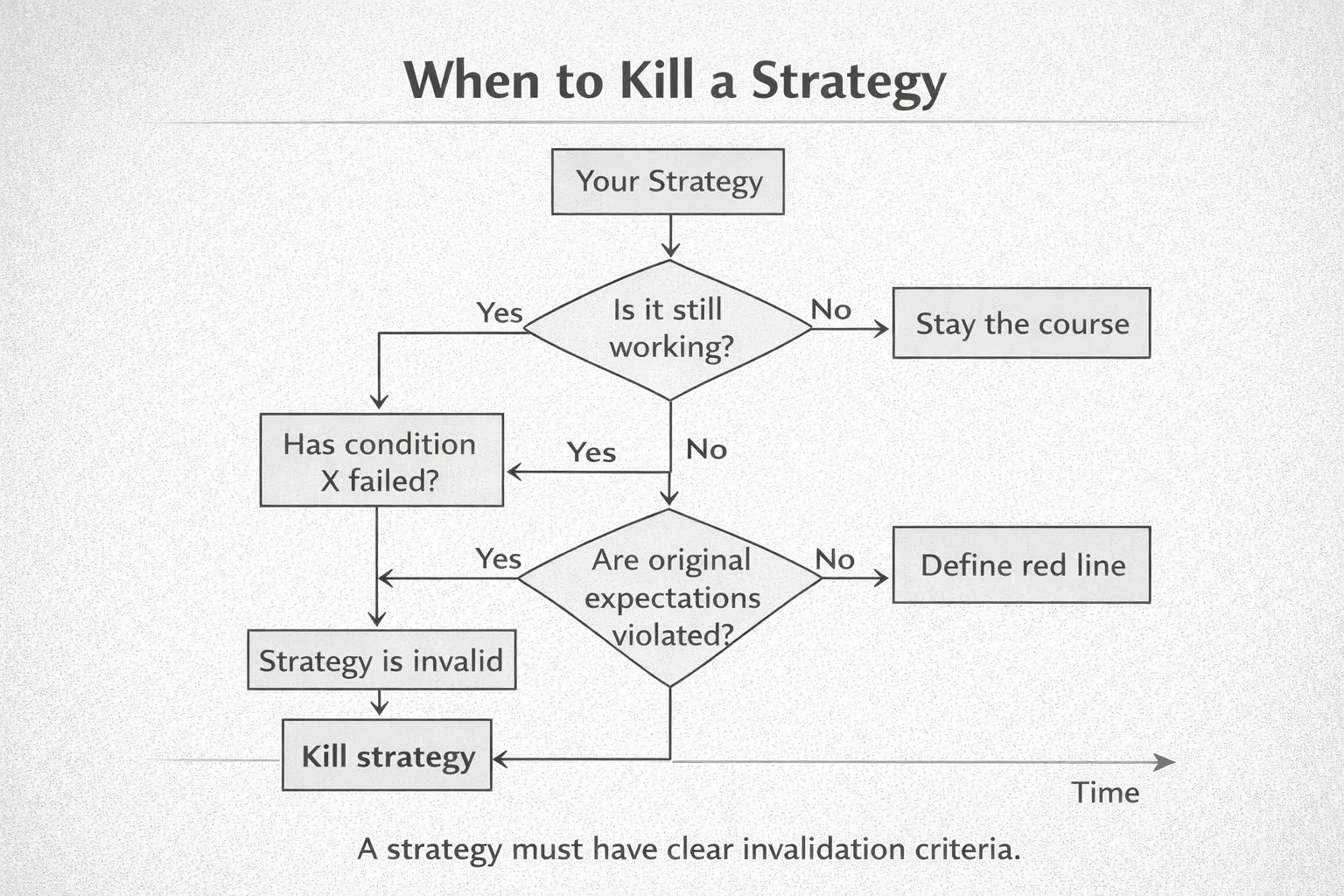
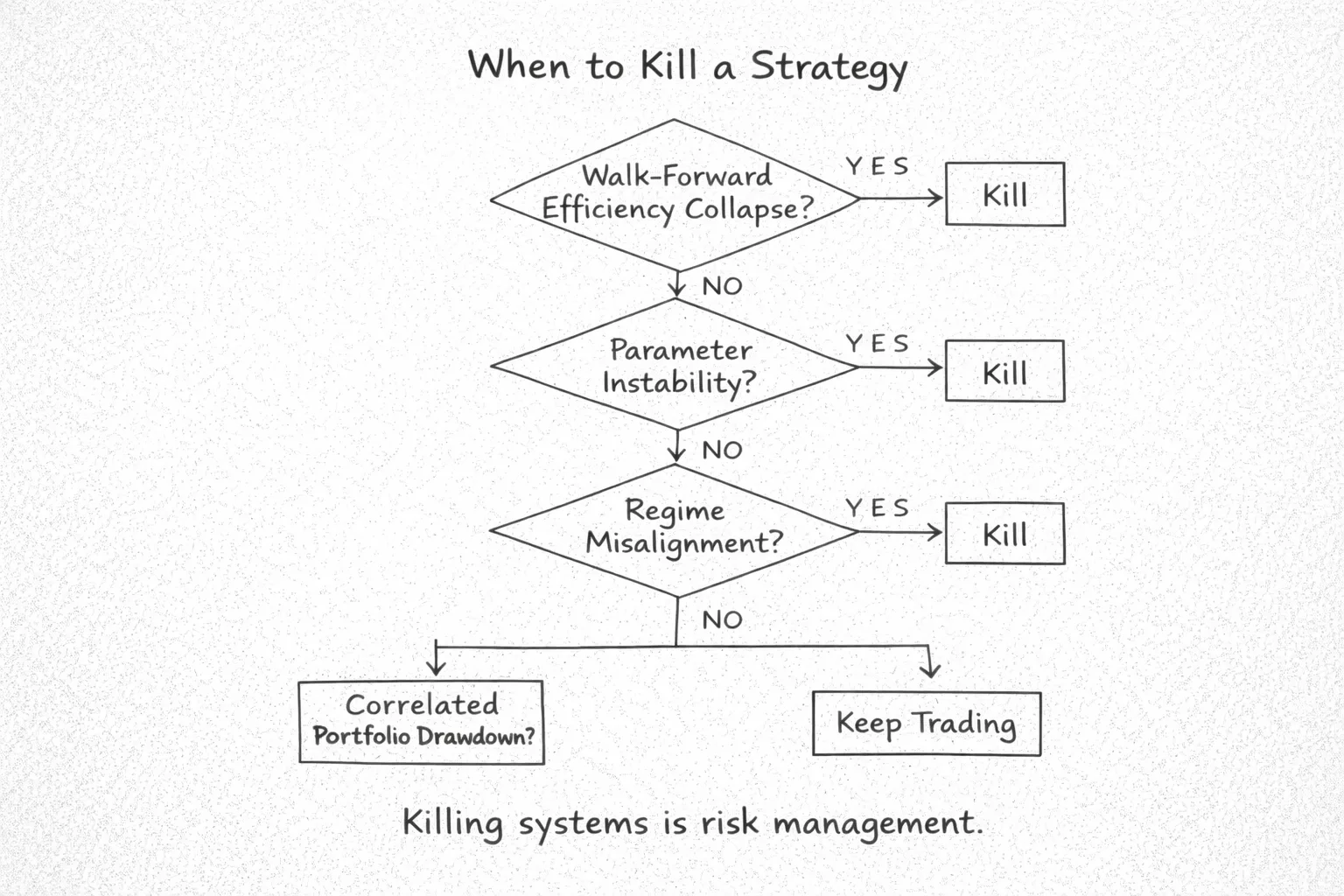
14. When to Kill a Strategy
The most important decision is not how to build a system — but when to stop trading it.
Walk-forward provides objective kill signals:
- Structural WFE collapse
- Parameter instability
- Regime misalignment
- Correlated portfolio failure
Killing a strategy is not failure.
Keeping a dead one is.
15. Walk-Forward Does Not Eliminate Risk
Walk-forward does not:
- Predict black swans
- Guarantee profitability
- Remove uncertainty
What it does is reduce self-deception.
16. Robust Strategy Design as Risk Management
Robustness is not about maximizing returns.
It is about:
- Capital survival
- Psychological sustainability
- Structural humility
Walk-forward is not an optimization technique.
It is a risk management philosophy.
Conclusion: Survival Over Precision
Markets do not reward intelligence.
They reward adaptability constrained by discipline.
Robust strategy design acknowledges uncertainty and designs around it.
Walk-forward analysis does not make systems profitable.
It makes them honest.
And honesty is the only durable edge.