From 270 StrategyQuant Builds to Live Funded Trading
How I generate, filter, validate and deploy trading algorithms — and why I use the same QuantMonitor research principles in my live trading with The5ers and FundedNext.
A profitable backtest is not the same thing as a trading strategy you can trust.
After years of developing and testing algorithmic strategies, I have learned that the biggest challenge is not generating an attractive equity curve.
The real challenge is building a repeatable process that separates fragile historical patterns from strategies worth considering for live trading.
Over the past months, I published a four-part series explaining exactly how I approach this problem using StrategyQuant X and our QuantMonitor templates and workflows.
Today I want to connect the entire process into one practical overview — and explain how these same research and validation principles are part of my live trading at The5ers and FundedNext.
From Research to Real Trading
I do not develop strategies only to publish attractive historical charts. I actively use algorithmic research and systematic trading techniques in real trading environments.
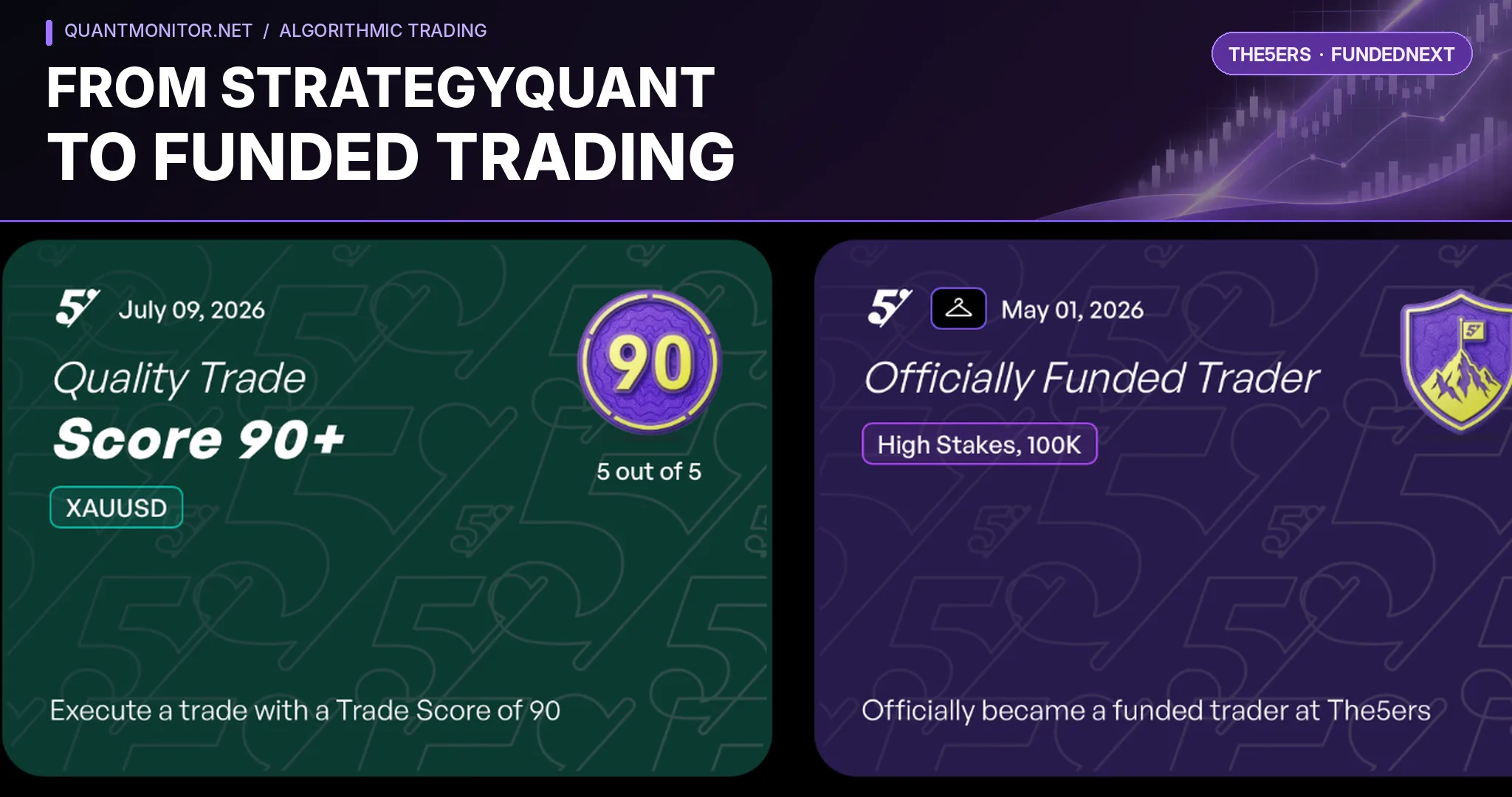
One example is my trading with The5ers, where my account dashboard records two achievements in 2026.
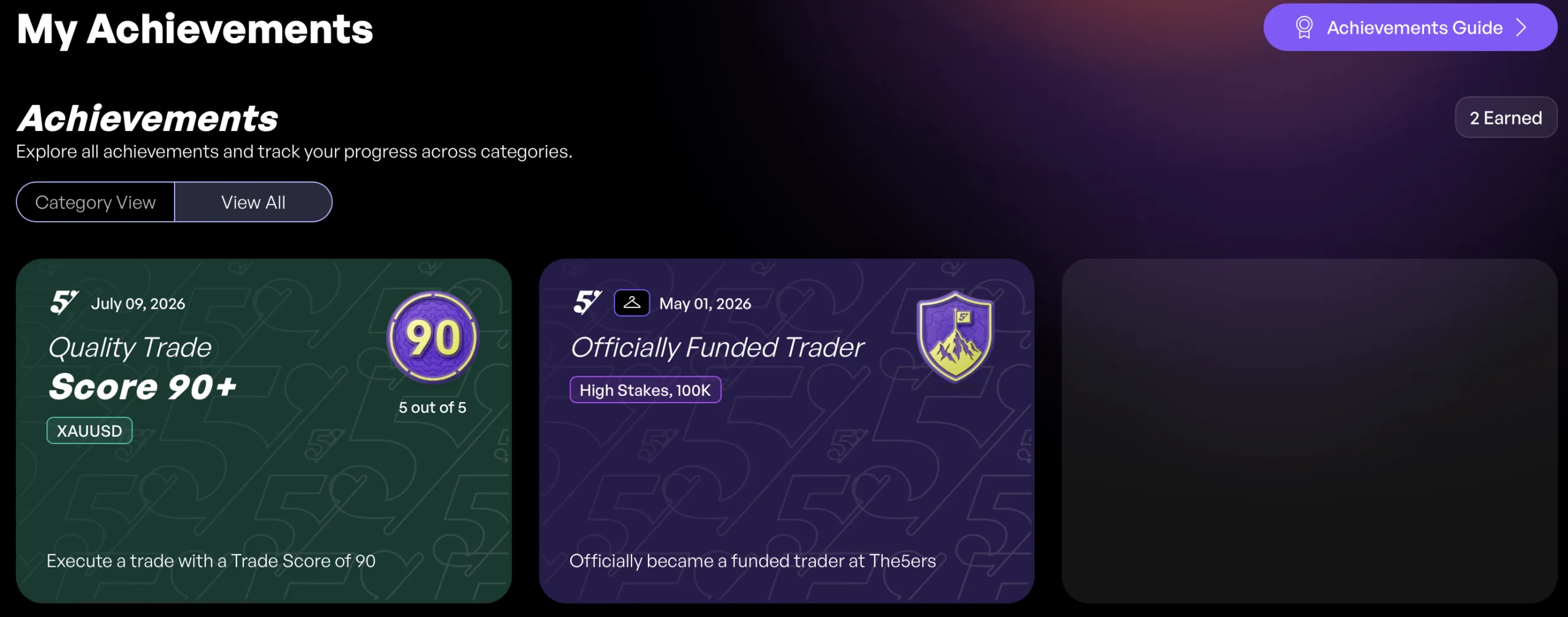
On May 1, 2026, I received the Officially Funded Trader achievement for a The5ers High Stakes 100K account.
On July 9, 2026, my achievements dashboard also recorded a Quality Trade Score of 90+ for an XAUUSD trade.
I also apply the same systematic research and validation principles in my live trading with FundedNext.
These achievements are not proof that every algorithm will work, and they do not represent a complete audited performance history. They illustrate an important part of my work: the research methodology I publish is also a methodology I use in practice.
The important distinction: I am not claiming that a particular screenshot proves the profitability of an algorithm or that any workflow guarantees a funded account.
What I can share is the systematic process I use to develop, reject, improve and validate trading strategies before considering them for live deployment.
The Complete QuantMonitor Research Workflow
The process is built around five connected stages. Each has a specific purpose, and each helps eliminate a different source of potential failure.
Generate Broadly Before You Optimize
My research begins with a broad universe of markets rather than one favorite trading instrument.
In the first major research cycle, I worked with approximately 15 instruments across multiple sectors and 9 premium breakout templates.
I tested two timeframes or build variants for each market-template combination.
The result was:
This broad research phase helps me discover which combinations naturally produce promising populations of strategies.
I am not looking for the single best backtest. I am looking for areas where a meaningful number of strategies exhibit similarly healthy behavior.
Filter Strategy Populations, Not Just Winners
Once the builds are running, the next challenge is organizing and filtering the results.
I divide my StrategyQuant projects into logical groups:
- Symmetric Breakouts
- Symmetric Pullbacks
- Asymmetric Breakouts
- Asymmetric Pullbacks
Each project corresponds to a specific combination of market, timeframe and template.
During the initial discovery phase, I typically keep up to approximately 3,000 strategies per databank.
I rank candidates primarily by Return / Drawdown Ratio, but I also examine the entire distribution of strategies that survive filtering and tick-data retesting.
A build with one exceptional strategy and hundreds of weak candidates is much less interesting to me than a build that repeatedly produces strong strategy clusters.
I then inspect individual equity curves, long and short performance, win rate, Profit Factor, average winning and losing trades, and extreme results.
Weak combinations are discarded. Promising combinations move forward.
Read Part 2: How I Configure Builds and Filter Trading Algorithms
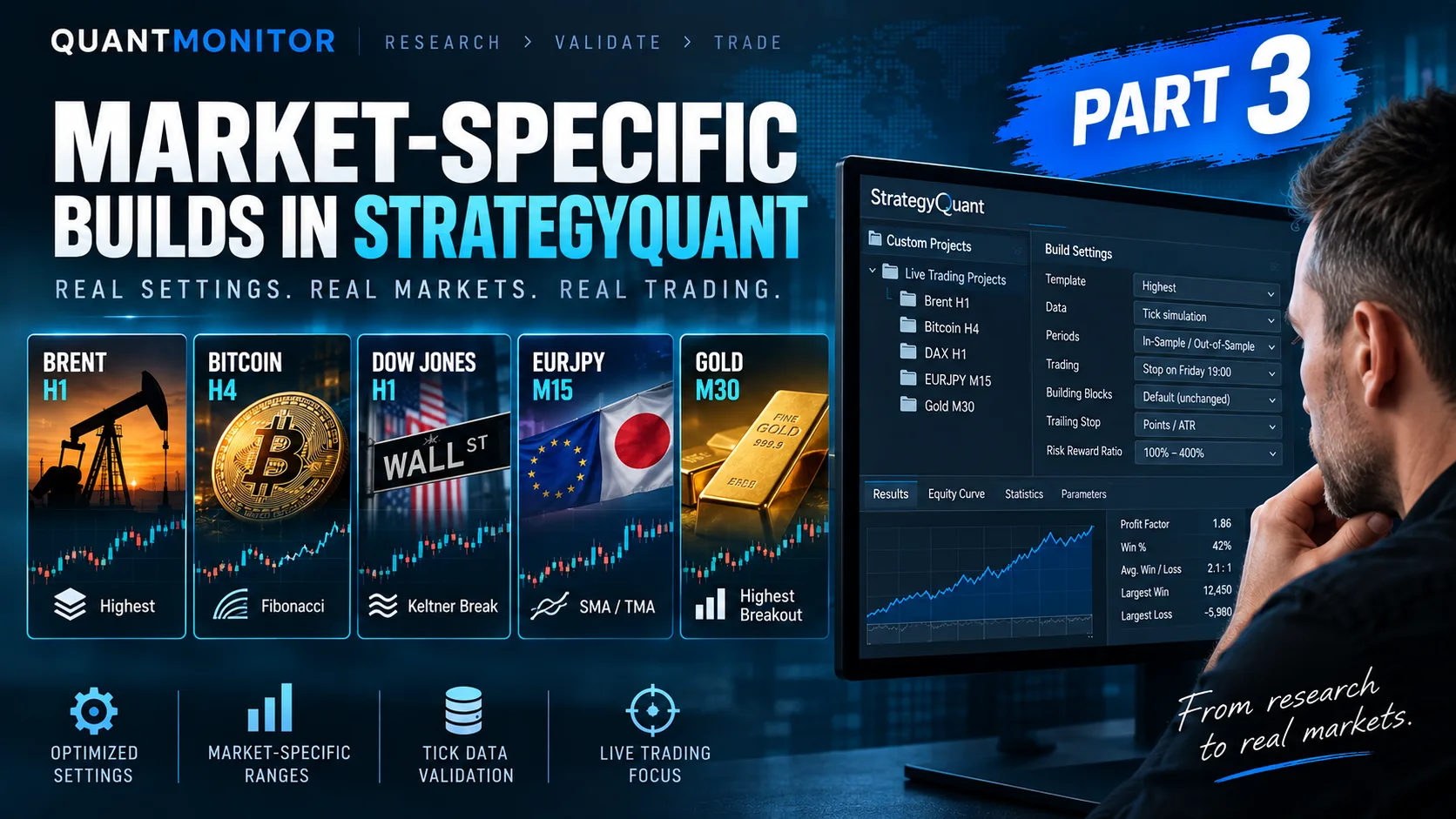
Adapt the Builds to Specific Markets
Once the broad research identifies productive combinations, I move into more focused development.
At this stage, I stop treating every financial instrument identically.
Gold behaves differently from Bitcoin. Brent behaves differently from EURJPY. An index strategy has different volatility and execution characteristics from a currency strategy.
I therefore adapt Stop Loss, Take Profit, trailing-stop and trailing-activation ranges to the relevant market.
Depending on the instrument, I use ATR-based or fixed-point parameter ranges and experiment with reasonable Risk Reward limits.
Some of the productive combinations identified in my published research include:
These are research examples, not a list of currently active live positions.
For focused builds, I increase the databank to approximately 6,000 strategies before filtering and retesting.
The objective is not to force a parameter set to fit the past. It is to find reasonable ranges supported by the behavior of the individual market.
Retest Everything That Matters
This is one of the most important parts of the entire workflow.
A strategy that survives the initial filtering process is only a candidate. It is not automatically ready for live trading.
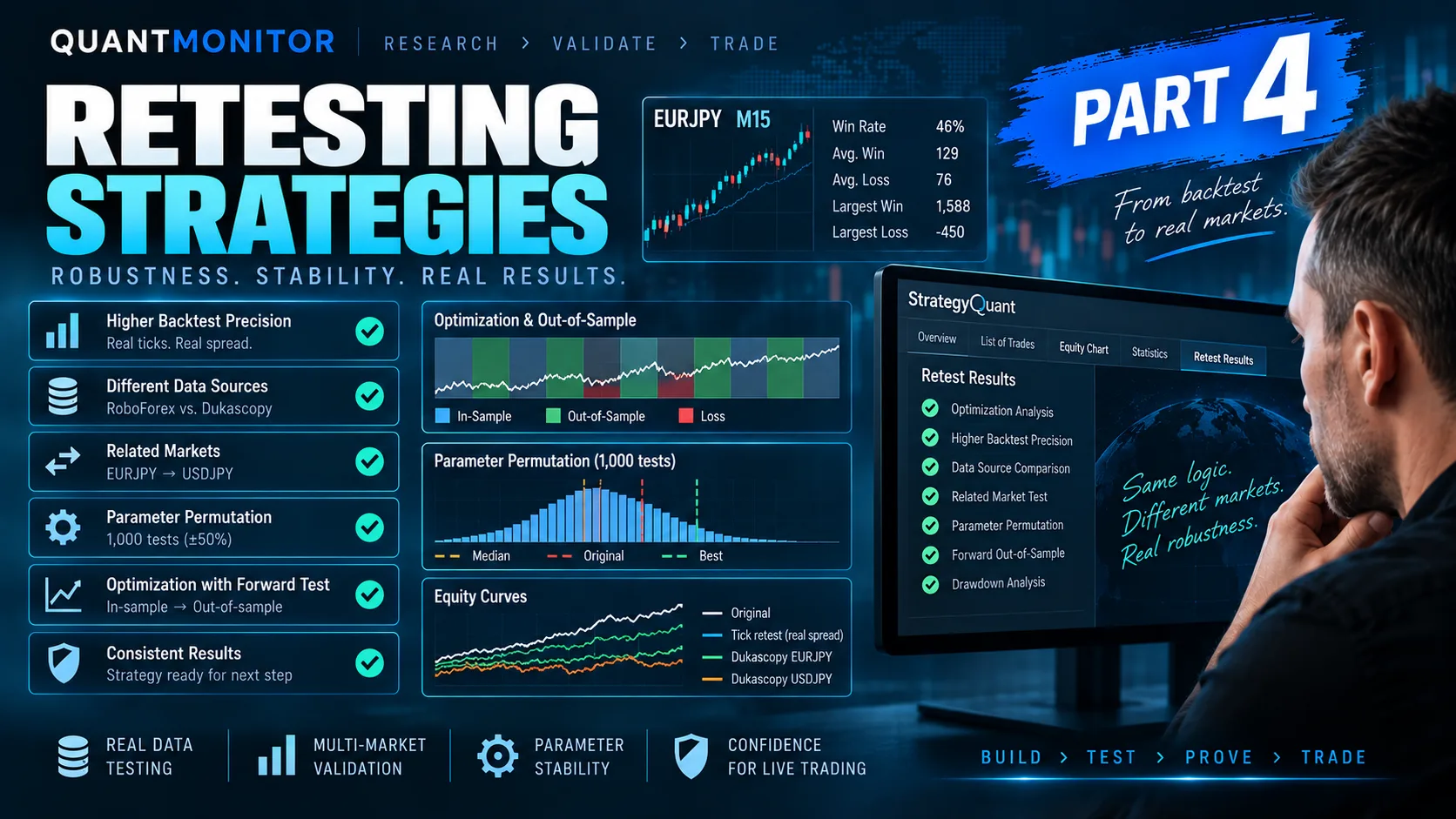
My deeper validation process includes:
- In-Sample, Out-of-Sample and True Out-of-Sample evaluation
- Higher backtest precision using real tick data and realistic spreads
- Testing on data from different providers
- Testing on related markets
- System Parameter Permutation
- Optimization with forward testing
- Analysis of drawdown distributions and parameter stability
In System Parameter Permutation testing, I may perform approximately 1,000 variations, changing parameters around their original values.
I am interested in whether the strategy remains reasonably stable across a wider neighborhood, rather than depending on one perfect historical parameter set.
I also compare behavior across different historical periods, data providers and related instruments.
The goal is not to prove that a strategy cannot fail. That is impossible.
The goal is to identify as many weaknesses as possible before live capital or account risk limits are involved.
Read Part 4: How I Retest Trading Strategies Before Live Deployment
Move From Research to Controlled Live Trading
Even a thoroughly tested strategy can behave differently in a live execution environment.
Spread, slippage, broker settings, execution quality and changing market conditions all matter.
For that reason, my approach to deployment does not end when StrategyQuant produces an attractive backtest.
I consider the behavior of each strategy in the target platform, its risk characteristics, its contribution to the wider portfolio, and the rules of the trading account.
This is especially important when working with funded-trading environments such as The5ers and FundedNext.
Account drawdown limits, execution restrictions, permitted automation, position exposure and other provider rules must be checked independently and respected.
Strategies and portfolios also require ongoing monitoring. A strong historical result does not remove the need for risk management during live trading.
Stop Starting Every Strategy From Scratch.
The research process described above requires much more than a collection of indicators.
You need structured templates, repeatable build configurations, reliable testing and a clear method for evaluating the results.
That is exactly why we created QuantMonitor Premium.
Our Premium membership includes:
- 9 trading robot templates
- 9 custom StrategyQuant workflows
- Video training and practical guidance
- StrategyQuant-related tools and utilities
- Deployment and backtesting tools
- Product updates and support
Instead of building your research infrastructure from zero, you can start with our existing templates and workflows and adapt them to your own markets.
StrategyQuant software is required to use the related products. Membership pricing and applicable taxes are shown at checkout.
What Funded Trading Has Reinforced About My Research
Using these principles in live trading has reinforced something I have believed for a long time:
It is relatively easy to generate thousands of strategies that look profitable on historical data.
It is much harder to build a process that consistently rejects weak candidates, identifies robust combinations, and handles the practical realities of live trading.
My work with StrategyQuant, the QuantMonitor research environment and funded trading accounts is connected by the same principles:
- Repeatability: Use a process that can be reproduced, compared and improved.
- Statistical discipline: Judge groups of strategies, not isolated winners.
- Market awareness: Adapt strategy parameters to market characteristics.
- Robustness: Test strategies on unseen data, with realistic assumptions.
- Risk control: Evaluate drawdown, exposure and account restrictions.
- Ongoing monitoring: Treat deployment as the start of another evaluation stage.
Why I Share the Complete Process
At QuantMonitor, our objective is not to sell an illusion of effortless automated trading.
We share the tools, templates, workflows and knowledge that form part of our own systematic research environment.
Traders can study the principles, reproduce the process, adapt it to their markets and perform their own validation.
The greatest advantage of a structured workflow is not that every strategy succeeds.
It is that you know how to research, evaluate and reject strategies consistently.
And that is a skill worth developing regardless of which markets you trade.
Ready to Build Your Own Algorithmic Trading Workflow?
You have seen the research process behind my strategy development and the principles I apply to live funded trading.
Now you can explore the same QuantMonitor ecosystem of StrategyQuant templates, custom workflows and supporting tools.
Spend less time setting up repetitive research tasks and more time understanding the strategies you develop.
Explore the Full Research Series
If you want to understand the individual stages in more detail, read the four original articles.
- How I Generate and Sort Trading Algorithms
- How I Configure Builds and Filter Trading Algorithms in StrategyQuant
- How I Configure StrategyQuant Builds for Specific Markets
- How I Retest Trading Strategies Before Live Deployment
Lukas Melka
Chief Algo Developer
QuantMonitor.net