Throughout this year’s live trading and the continuous monitoring of a wide spectrum of strategies, one pattern has become increasingly evident:
Scalping strategies on the NASDAQ 100 are disproportionately vulnerable to unexpected losses — often several times larger than the defined stop-loss.
This observation directly connects to the earlier article:
🔗 Unexpected Gap Hits Stock Index Strategies
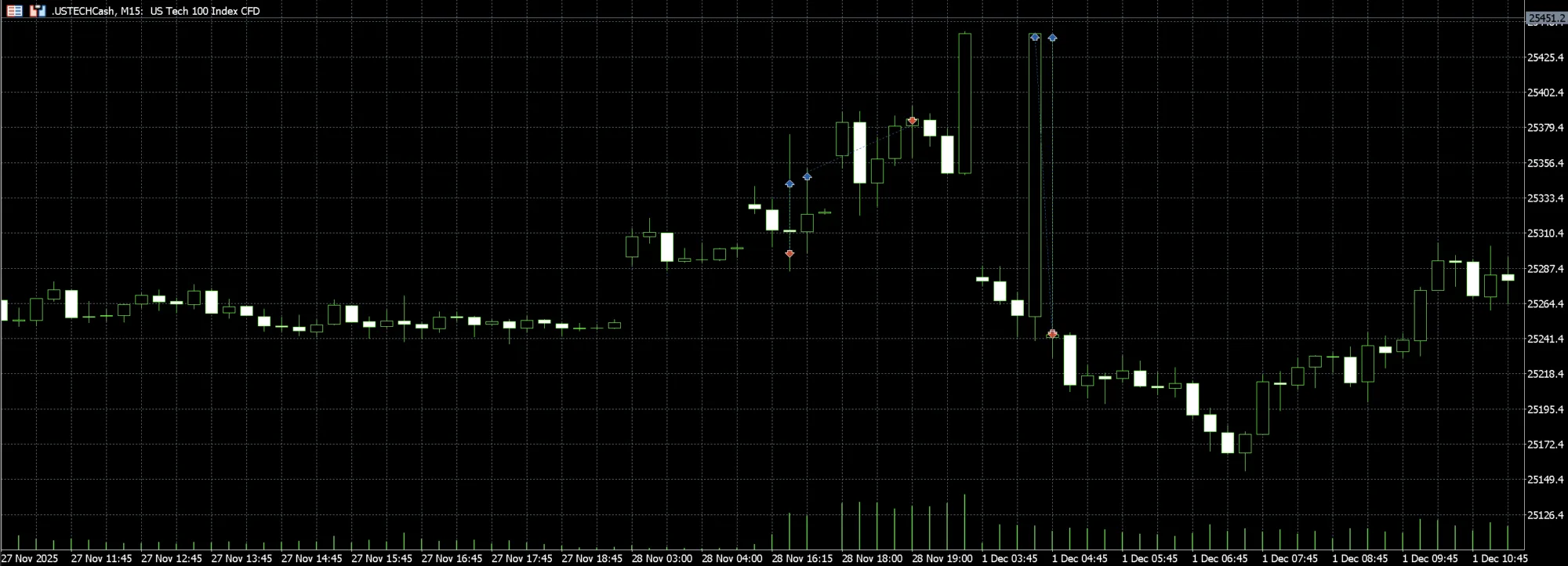
While most strategies behave consistently with their backtests, NASDAQ scalpers are exposed to rare but severe anomalies that simply do not appear in historical simulations — mainly session gaps and periods of extremely low liquidity during the first minutes after market open.
What Actually Causes These Oversized Losses
1) Session Gaps
NASDAQ occasionally opens with:
- a sharp discontinuity in price,
- a jump outside the expected structure,
- a print far beyond the intraday range.
When this happens, the market skips through the stop-loss entirely, producing losses several times larger than the model assumes.
In recent live trades, the pattern has been obvious — the strategy is long, the session opens, and the price appears in a completely different universe.
2) Low Liquidity After Market Open
This is especially visible on CFD instruments (e.g., USTECHCash).
During the first minutes after open:
- spreads widen aggressively,
- partial fills occur,
- price slips through thin liquidity by dozens of points.
This creates a new category of losses — not caused by the strategy itself, but by the execution environment.
In other words, the instrument does not behave like the underlying NASDAQ futures.

How to Solve These Edge-Case Failures
After months of live tests, two safe and logical approaches stand out:
🟢 A) Scalping strictly intraday
No overnight positions =
no gaps = no catastrophic slippage on stops.
Losses remain within expected limits, and the equity curve stays smoother and more predictable.
🟢 B) For intraweek trading, use strategies with wider targets and wider stop-losses
Strategies that:
- aim for larger point profits,
- tolerate broader price swings,
- operate with wider stops,
- use higher-range market structure,
are dramatically more robust.
Why?
Because a 30% stop-slippage is a normal market anomaly, while
a 300% stop-slippage breaks the entire risk model.
Larger targets and wider stops allow the strategy to absorb:
- liquidity holes,
- overnight gaps,
- sudden volatility spikes,
- CFD execution noise.
Conclusion
This year, NASDAQ scalping has repeatedly shown that:
- extreme speed + early-session illiquidity + structural gaps = a combination capable of producing losses that simply do not exist in backtests, and
- robustness must be engineered not only mathematically, but also with regard to the real execution behaviour of the instrument.
For this reason, I’m shifting intraweek trading toward higher-range systems with wider targets, while keeping scalping strictly intraday — where its logic is intact and risk can be controlled reliably.