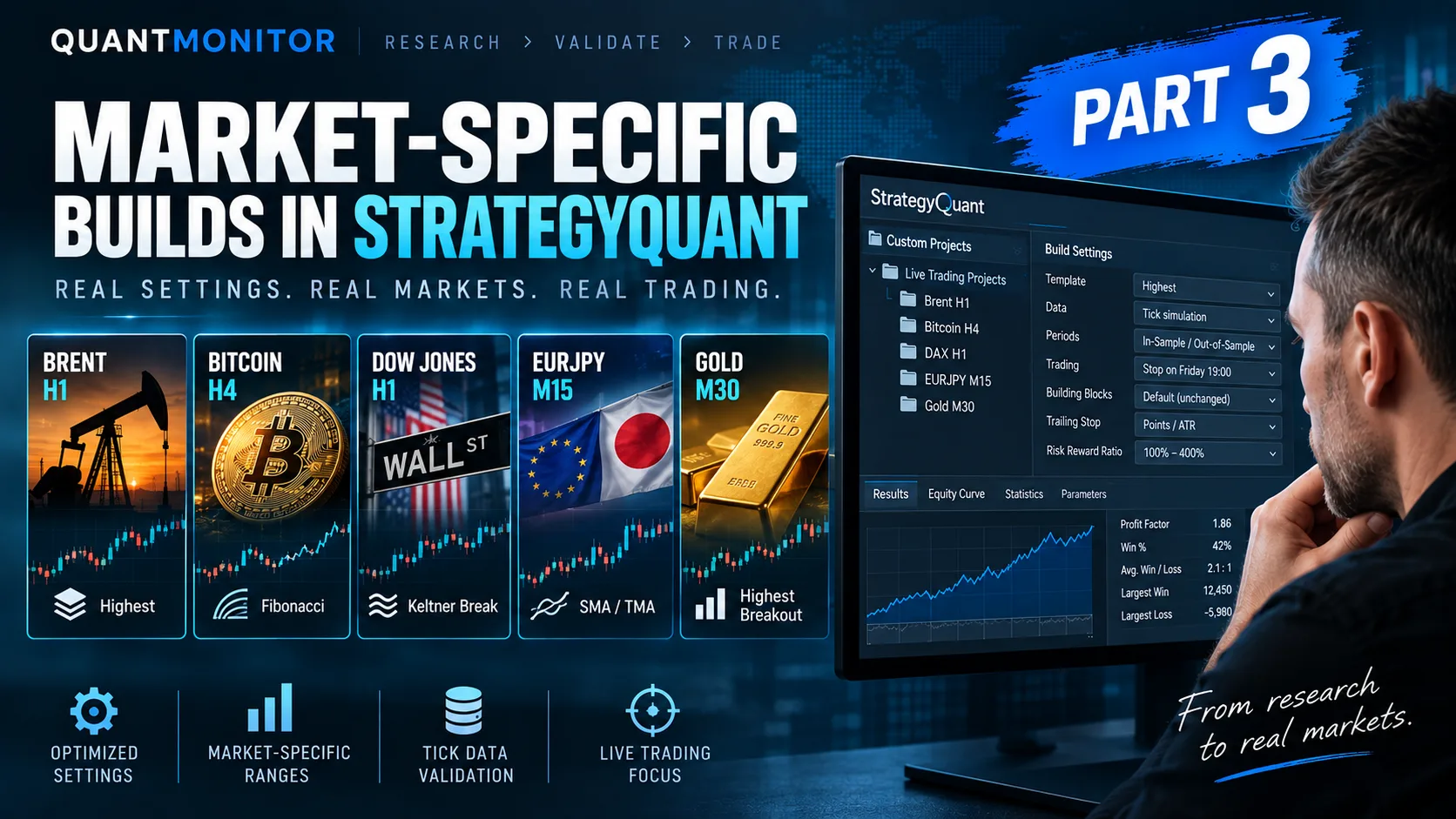
Algorithmic trading — often shortened to algo trading — means using a computer program to enter and exit trades automatically, following a fixed set of rules instead of deciding by hand. The rules are tested on historical data before they ever risk real money. This guide explains how algorithmic trading works, whether you need to code, how to get started step by step, the metrics that actually matter, and the risks nobody should hide from you.
How algorithmic trading works
An algorithmic strategy is just a set of explicit rules — when to enter, when to exit, how much to risk — that a computer follows without hesitation. The workflow is the same whether you trade forex, stocks, futures or crypto:
- Define the rules — a hypothesis about when the market offers an edge (a trend, a reversal, a breakout), written as exact conditions.
- Backtest — run the rules over years of historical price data to see how they would have performed.
- Validate robustness — stress-test the result so you don’t trade a fluke (more below).
- Deploy — connect the strategy to a broker or platform so it trades automatically.
- Monitor — watch the live system, because a strategy that worked yesterday can stop working.
The discipline is the whole point: rules trade your account, not your feelings.
What can you trade — and with which strategies?
Algorithms trade the same markets people do — forex, stocks and ETFs, futures, options and crypto. The common strategy families are:
- Trend following — ride sustained moves up or down.
- Mean reversion — bet that price returns to an average after stretching too far.
- Breakout — enter when price leaves a range.
- Arbitrage — exploit small price differences, usually the domain of well-funded firms.
None of these is magic. Each works in some market conditions and fails in others, which is why regime awareness and validation matter — see our guide on identifying market regimes and filtering strategies.
Do you need to know how to code?
Not necessarily. No-code tools can cover many common workflows, while custom indicators, integrations and advanced research may still require programming. There are two paths:
- No-code generators build and test strategies visually, so you never write a line of code. StrategyQuant X, AlgoCloud, Build Alpha and EA Studio work this way — you can even start with a free StrategyQuant trial.
- Code-first platforms such as QuantConnect and TradingView’s Pine Script give programmers full control in Python, C# or a scripting language.
We compare both paths in our roundup of the best algorithmic trading software. Beginners usually get further, faster, with a no-code tool.
How to get started with algorithmic trading (step by step)
- Learn the fundamentals — markets, order types, risk, and above all what a backtest can and cannot tell you.
- Choose a tool that matches your skills — no-code vs code-first (see the comparison above).
- Write down a clear hypothesis before you build — a reason the edge should exist.
- Backtest on quality historical data for the exact broker and symbol you’ll trade.
- Validate robustness — out-of-sample tests, Monte Carlo and walk-forward analysis separate a real edge from curve-fitting. Learn to read the results with R-expectancy and robustness metrics and StrategyQuant’s robustness tests.
- Deploy the finished strategy — here’s how to run a strategy in MetaTrader.
- Monitor it live and know when to switch it off — set up uptime and platform monitoring.
The metrics that tell you if a strategy is any good
A pretty equity curve isn’t evidence. Judge a strategy on hard numbers:
- Profit factor — gross profit divided by gross loss; above 1 means profits beat losses, but it is only meaningful alongside trade count, costs, drawdown and out-of-sample results.
- R-expectancy — average profit per unit of risk.
- System Quality Number (SQN) — the quality of the edge across many trades.
- Maximum drawdown — the worst peak-to-trough loss you would have had to sit through.
Look at them together; any one in isolation can mislead.
The honest risks
Algorithmic trading can reduce emotional decisions during execution, but it removes neither the risk nor the discipline you need to design, monitor and change a system. Be clear-eyed about:
- Overfitting — the biggest trap. Test enough combinations and something will look perfect on the past and fail live. Robust validation is your only defence.
- Costs — spread, commission, swap and slippage quietly erode a backtest that ignored them.
- Execution and infrastructure — a disconnected VPS or a broken data feed can turn a good strategy bad.
- No guarantees — no algorithm can promise profit; anyone who says otherwise is selling something.
A historical backtest is evidence, not proof.
Frequently asked questions
Is algorithmic trading profitable?
It can be, but most strategies fail validation, and profitability depends on discipline, costs and risk control far more than on the algorithm itself. Treat backtests as evidence, never a promise.
Is algo trading legal?
Algorithmic trading is generally permitted for retail traders, but the rules differ by country, broker, exchange and instrument — always check the terms that apply to your account. In most regulated markets you are simply automating your own orders.
How much money do I need to start?
You can learn, build and backtest for free. Live-trading amounts depend on your broker and your own risk limits — start small, and only after a strategy has survived honest validation.
Can beginners do algorithmic trading?
Yes, especially with no-code tools — but budget time to understand backtesting and risk before you go live. The tools are easy; the discipline is the hard part.
Educational content only, not investment advice. Algorithmic trading carries substantial risk of loss and is not suitable for everyone. Past and backtested performance is not indicative of future results.